
In batteries, "rebound" refers to the recovery (also called voltage relaxation) of the SoC (state of charge) after use. This effect is increasingly observed to a greater extent in aged batteries whose SoH (state of health) has significantly deteriorated. The reason for this is a change in the battery's internal resistance. As the battery ages, its internal resistance increases, leading to a greater voltage drop under load. Consequently, the voltage relaxation is also higher.
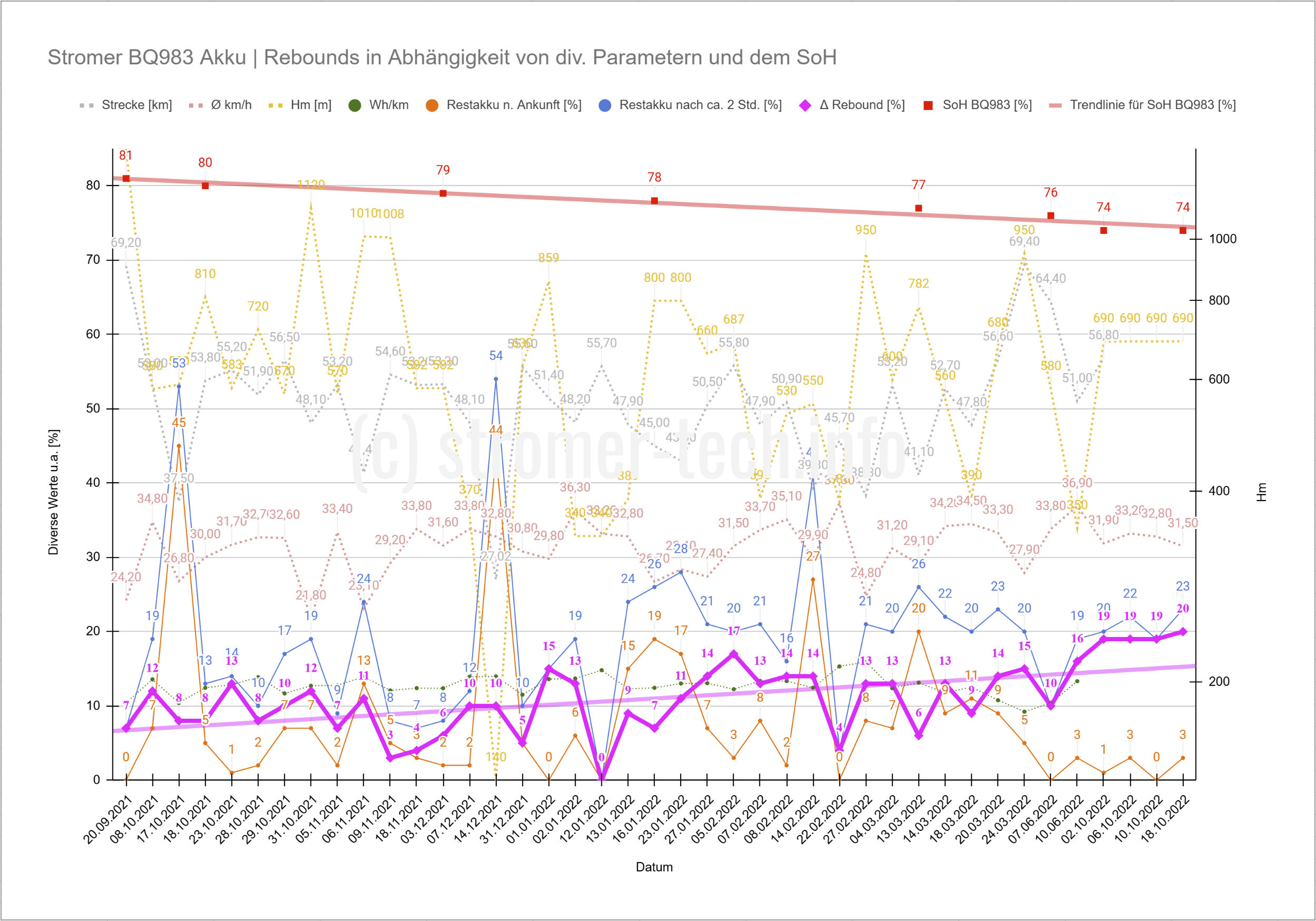
The following graph shows the rebound effect for a BQ983 battery over a 13-month period and within the SoH range of 81–74 %. The number of kilometers driven, the route profile, and the outside temperature (0–22 °C during the observed period) do not play a role. The rebound increases, and the SoH decreases.
Sudden failure of the power line
Aged batteries sometimes show spontaneous failures in support, in addition to the rebound effect. The e-bike's motor suddenly switches off, even though the Omni display still shows sufficient remaining capacity.
The two phenomena are related in that they particularly occur with older batteries. Spontaneous failure of the support is more frequent at colder temperatures. Lower temperatures further increase the so-called internal resistance of lithium-ion batteries in addition to the aging effect. When riding with high support, more energy is drawn from the battery. In combination, this can temporarily lead to the battery's „cut-off voltage“ being undershot, causing the support to fail. After restarting the e-bike, one can usually continue riding for a while with weak support.
Sooner or later, the only solution is to buy a new battery or have it reconditioned with new cells.
See also BATTERY - ,Repair / Refit / Refurbishing / Used Equipment‘