
Is that possible? The simple answer is YES...but
In connection with the care of Li-ion batteries, people sometimes speak of “battery voodoo.” This refers to excessive care aimed at increasing the number of cycles or the lifespan of a cell/battery. In principle, one can assume that with batteries that have a Battery Management System (BMS), this system is designed to get the optimum between performance and lifespan out of the battery. The Stromer BMS also does this.
The cycle life of a cell/battery can be increased by treating the cell with particular care and operating it exclusively within normal specifications, meaning keeping the discharge and charge currents low. However, if you don't want to operate an e-bike at its limits, it's difficult since it's intended as a commuter bike to get from A to B quickly.
Nevertheless, there are ways to support the BMS and extend battery life.
See Regarding the topic: BATTERIES – ,Care: Mechanical / In Operation / Storage / Safety‘
See Regarding the topic: BATTERIES – ,Aging - SoH Loss ‚
In addition to the points described in the two topics, the user can also do the following:
1. charging at... °C
Outside temperature > 10 °C In midsummer, the Stromer should not be left out in the blazing sun for long periods. After a ride in midsummer with maximum assistance, the battery temperature can rise above 40 °C. You should allow the battery to cool down before charging it.
Outside temperature < 10 °C A distinction must be made here as to whether one:
a.) has been driven longer and the battery has developed 'intrinsic heat' or
b.) wants to make a cold start
If the battery has cooled down (b), it should first be warmed up in a temperature-controlled room, then charged and only inserted shortly before the journey.
2. limit the loading stroke
Charging a battery from 0 to 100%is called a full charge cycle. Common NMC cells can undergo approximately 350-500 such charge cycles before they reach End of Life (EoL). Depending on the definition, EoL is at 60-80% of the nominal capacity. myStromer AG defines EoL at 75%.
If the charging stroke (DoD = Depth of Discharge) is limited, it is possible to double (or even more) the charging cycles and therefore the service life. More on this topic can be found here or here read more.
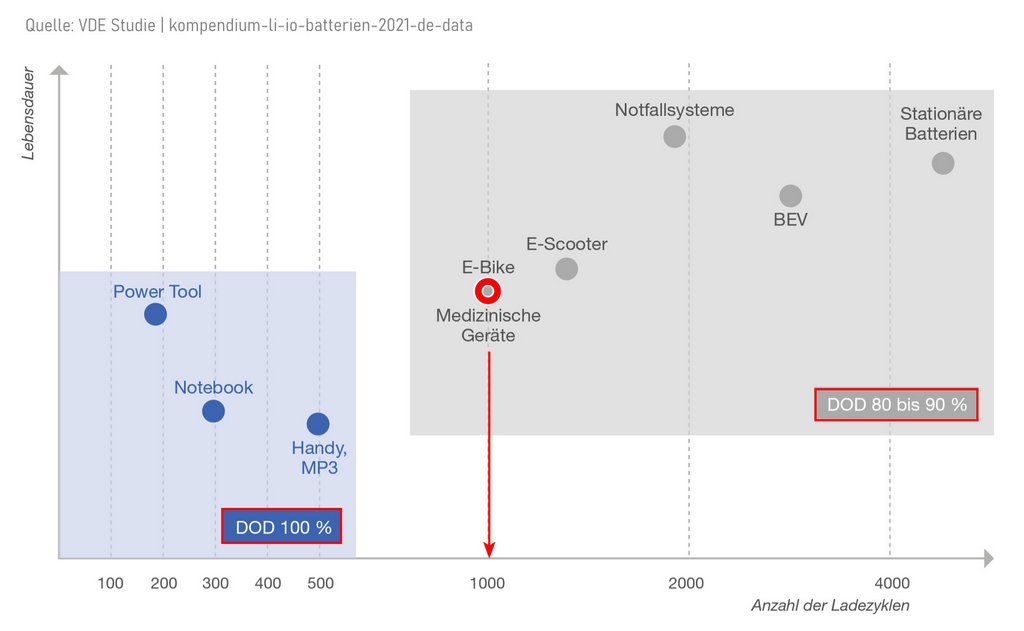
If a battery is regularly run down to 0% SoC and then recharged to 100%, this will shorten its service life. The following applies:
- If the battery is charged to 100% and driven straight away, this is not ideal but is harmless. Leaving it at 100% for longer will shorten its service life in the long term.
- If the battery is completely discharged and you leave it lying around (without recharging) there is a risk of deep discharge. This damages the battery permanently.
Many battery manufacturers use the BMS to limit the amount of energy effectively available from the outset in favor of the service life and create a buffer at the top and bottom. The display of 0% capacity therefore does not necessarily mean an empty battery and 100% a full battery.
Is it possible to set the charging stroke or upper charging limit on the Stromer?
Stromer does not offer a charging stroke limit or SoC upper limit setting. The battery is always fully charged. To achieve a partial charge, you have to use a timer, a smart socket or DIY.
- Timer: An empty battery is charged approximately with 22% (BQ983) or 33% (BQ814) per hour
- DIY solution: Patrick Doyle (Arduino)
- SmartPlug from bikechef.at
- Smart socket with home assistant: stromerforum.ch - from 'berghamster'
- Charging calculator: stromerforum.ch
- Limit 'battery charge' - Thread in the stromerforum.ch
3. use recuperation with caution
The maximum recuperation current is 15 amperes, with the old ST1, depending on the firmware, 4.5 to 6 A. To protect the battery, this is reduced as the battery charge level increases. As a result, recuperation is only weak or no longer noticeable when the battery is almost fully charged.
Recuperation stage 4 & 5 (classic recuperation) “pushes” approx. 2.5 A of current into each cell string of a 13S/6P batteries. This value is around 0.8 A, or almost 50 %, above the recommended charging current of 1.7 A for a Panasonic NCR 18650 GA (used in the BQ983, among others) and can reduce its service life. The recuperation levels 4 & 5 should therefore be used with caution, especially for longer periods of use, e.g. a descent down a mountain pass.
4. use additional battery (extender)
A sustainable way to extend the service life is to use an additional battery (extender) in parallel with the main battery. This has the following advantages:
a.) The maximum peak discharge current per cell is reduced
b.) When using maximum recuperation, the cells are not overloaded. (See point 3)
c.) Regular charging is gentler because the charging current per cell is further reduced.
Lifetime calculator
Stephan Klapszus has a Online calculator This can be used to set various parameters such as the SoC (State of Charge), the DoD (Depth of Discharge), the number of charging cycles/week, the charging speed, etc. The result is the number of possible charging cycles and an estimate of the service life in hours. The result is the number of possible charging cycles and an estimate of the service life in years. SK emphasizes that these values are an approximation based on a mix of different Li-ion batteries. For more precise results, a separate calculator would have to be implemented for each battery type.