
Wenn der Akku nicht mehr geladen werden kann ist die Ursache manchmal eine sog. Tiefentladung. Dies passiert meist aus zwei Gründen.
Grund 1: Der Akku wird unsachgemäss, meist mit zu geringem Ladestand, in die Winterpause geschickt und/oder falsch gelagert. Wie das verhindert werden kann steht in den Safety instructions to the battery, the Operating instructions or under BATTERY – 'Care: Mechanical / in operation / storage / safety'
Stromer writes the following regarding storage:
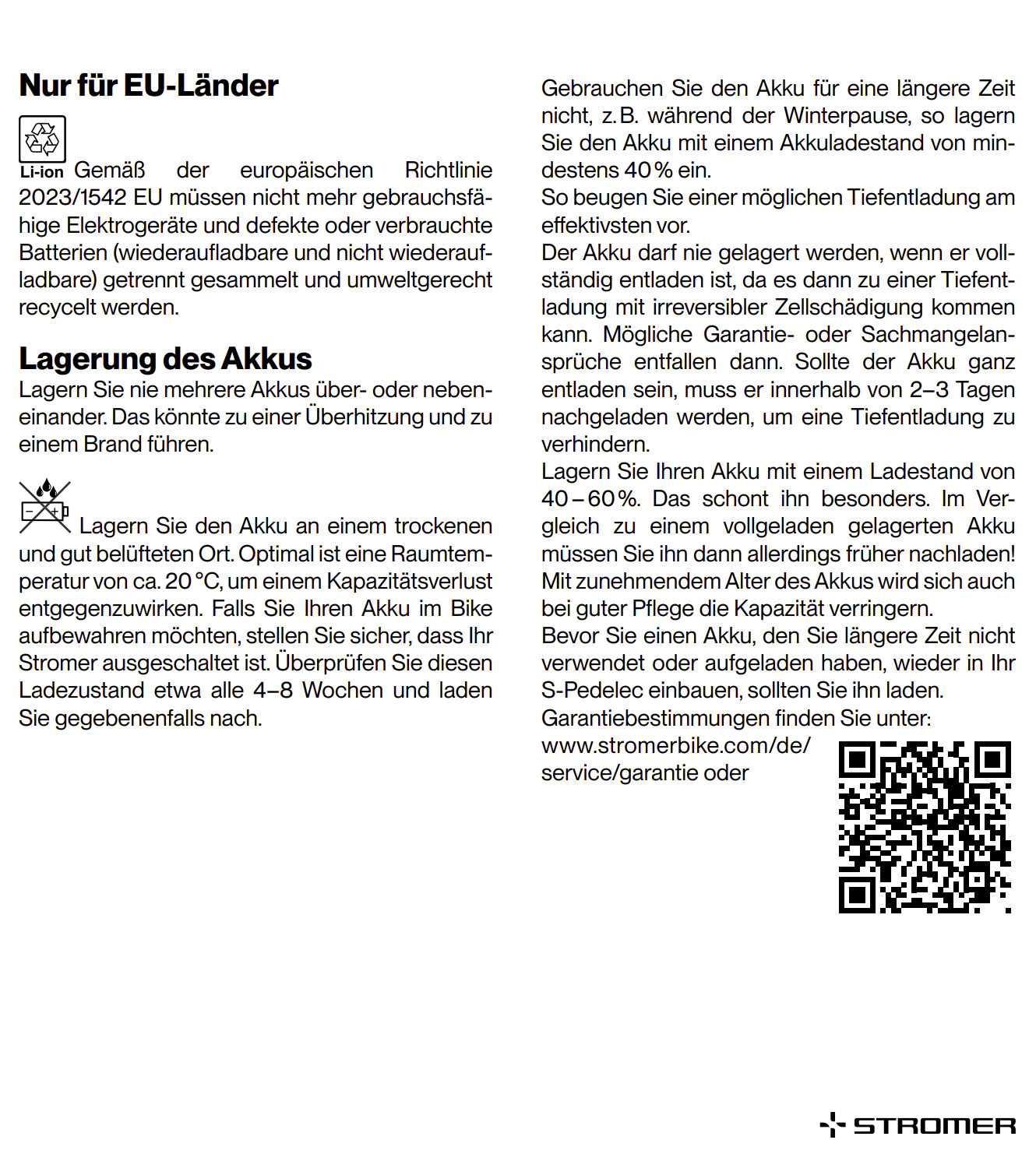
Grund 2: Eine eher unwahrschinliche Variante ist, dass der Stromer unabsichtlich in den Diebstahlmodus versetzt wird. Schiebt man den Stromer nur 2 bis 3 m schaltet dieser in den Diebstahlmodus. Der Stromer meldet dies durch Blinken des Tagfahrlichts und durch Huoen, falls dies in den Einstellungen so einegestellt ist. Weiter wird eine E-Mail an den mit dem Stromer verbundenen Account gesendet. Im Diebstahlmodus verbraucht der Stromer aufgrund der nun permanenten GPS-Ortung wesentlich mehr Energie. Ein voller BQ983 Akku ist in etwa 10 Tagen leer.
Why does deep discharge happen, can it be prevented?
Self-discharge is a physiochemical process that fundamentally unstoppable Each individual cell in a Li-ion battery experiences self-discharge due to its chemistry. These processes occur even without any external circuitry – purely internally within the cell. This self-discharge is called calendar aging. It arises from several mechanisms:
- Electrochemical side reactions at the electrodes (e.g., SEI layer growth)
- Ion diffusion through the separator
- Parasitic leakage currents within the cell itself
In a battery pack, several cells and the BMS are connected. Even a modern BMS consumes standby power, around 10–50 µA, so it's an additional consumer on top. It doesn't „see“ the internal cell currents because they don't flow through external wires.
When a lithium-ion battery stored long enough wird (Monate bis Jahre), sinkt die Spannung irgendwann unweigerlich unter den kritischen Spannungswert von 2,5 V – besonders wenn:
- The storage temperature is high (greatly accelerates self-discharge)
- The BMS itself draws power (typically 20–100 µA)
- The cells are already aged
This leads to irreversible damage, loss of capacity, and a potential fire hazard due to internal short circuits.
A good BMS, correct handling, and storage can delay but not prevent deep discharge if no counter-measures are taken.
You can find more details on this in my compendium on Li-ion batteries under AKKU - 'Theory & terminology compendium for Li-ion batteries' read more.
Was sagt Stromer zum Thema „Tiefentladung“? See folgenden FAQ-Eintrag.
What can you do with a Stromer if the battery can no longer be charged?
The following points can still be tried without security risks before a new battery becomes necessary.
- With a bit of luck, a battery may only appear to be deeply discharged, with the cell voltage still above the critical 2.5V but below 3.2V. Above 3.2V, a Li-ion cell is considered empty (0% capacity). This threshold is relevant for most chargers. They will not charge the battery for safety reasons if the voltage drops below 3.2V.
The Stromer charger CR245 (& CR65) has a hidden capability. It can revive such a battery, if necessary. This is referred to as «nurturing.».
Verbinde den Akku mit dem Ladegerät und ziehe den Ladestecker nach 30 Sekunden wieder ab. Wiederhole das Prozedre mehrere male und beobachte die Ladeanzeige des Ladegeräts. Mit etwas Glück beginnt das Ladegerät dem regulären Ladevorgang. Wenn nicht lasse das ladegerät 1 – 2 Tage am Akku angeschlossen.
Das neuere CR246 hat diese «Aufpäppelfunktion» nicht, dafür bietet es eine «Schwebeladung» an. - One can no further Send the battery to Stromer via the dealer. Stromer doesn't repair batteries, but they can reset the self-protection and reactivate the battery. The same applies here: if the cell voltage has dropped below 2.5 V, Stromer will no longer reactivate the battery.
- As last chance Is there still the Battery replacement. However, the respective company must offer the option to reset the SoH and charge cycle counter. And a reset is only possible with HTE batteries with 3 screws.
Further information can be found at AKKU - ‚Repair / Battery Refurbishing / Used Items‘
Conclusion
The typical self-discharge rate of a Li-ion battery at room temperature is about 1–3 % pro Monat (Stromer = 4%, see above). At 20°C and with a properly stored battery, it therefore takes many months to years, until the critical cell voltage limit of 2.5 V is reached.
Tips for Long-Term Storage:
- Charge level at ~40–60 % store (not full, not empty)
- Store in a cool place (10–15°C ideal) – significantly slows down the chemistry
- Battery management system with sleep mode choose one that reduces self-consumption to <5 µA
- Reload periodically (every 3–6 months) or use the CR246 with floating charge.