
Costs (comparison)
Whether belt or chain – opinions differ here. The preferred type of drive is probably a matter of taste, conviction, or practical experience.
Tristan Ridley describes his practical experience with chain and belt drives in a YouTube video with the provocative title „Chains are STILL better than Belts for Bicycles“. He describes why he switched back from the belt to the chain and why, through clever marketing by the belt manufacturers, the widespread myth of the supposedly superior performance of the belt drive is at least questionable.
However, very few daily commuters are „Tristan Ridleys,“ and the main goal is to get from A to B quickly, usually on good surfaces. The only questions that arise are about convenience (care, maintenance) and, if applicable, the cost of wear parts.
When comparing chain and belt drives, there is a clear winner.
| Component | Model | Market price | Electricity price |
|---|---|---|---|
| Strap | Gates CDX-133T | 85 € | 130 € |
| Chain | KMC e11 EPT | 36 € | 50 € |
| Pulley (front) | CT1139PBA | 90 € | 180 € |
| Pulley (rear) | CT1122SMN | 85-90 € | 120 € |
| Chainring (e.g. ST3/5) | Gossamer 52T | - | 58 € |
| Sprocket (11-speed) | Shimano 11 sprocket | from ~4 € | - |
Belt specifications suitable for: ST2 / ST3 / ST5 / ST7 with Pinion gearbox
Total costs
| Chain drive Price basis = electricity price | Belt drive Price basis = electricity price | Belt drive Price basis = free market |
|---|---|---|
| 128 € | 430 € | 265 € |
In addition to the parts costs, there are labor costs of €80 – €150, depending on the workshop's hourly rate. The stromerforum.ch user Chnuke reported that he paid CHF 484.50 (including labor) for the replacement of the entire belt drivetrain on his ST7.
Life expectancy
So far, the belt drive doesn't look good in terms of cost. This is where the lifespan of the wear parts and maintenance come into play, which could turn the tables. Does it? Here's the relevant information.
- With the 'KMC e11 EPT' chain mostly used by Stromer, you can expect a mileage of around 10,000 km.
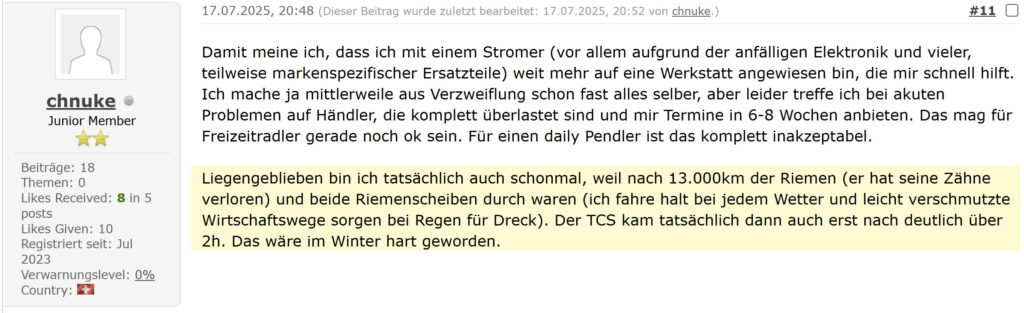
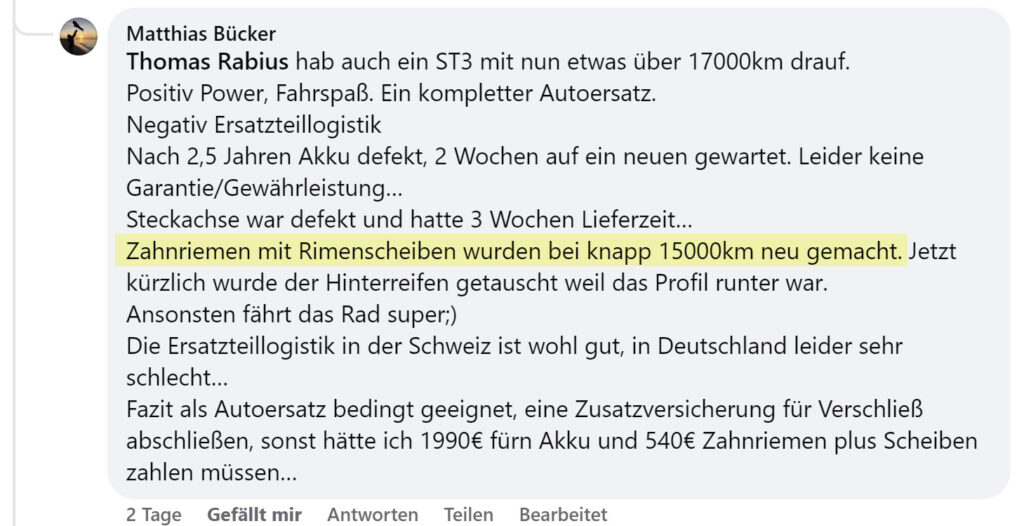
- A Gates CDX belt and the belt pulleys reach around 20,000 to 30,000 km according to advertising.
Both values are valid only with regular maintenance. Especially with the belt, this is often neglected because the description ‚low maintenance‘ is often equated with ‚no maintenance required‘ in practice. The consequences are heavy wear, even defects in the drivetrain, and a massively reduced lifespan. Here are two examples from stromerforum.ch and from Facebook.
The strap has the advantage that no oil or wax needs to be used for care, only water, a brush, and possibly dry silicone spray (e.g. Gates Carbon Drive BELT CARE Belt maintenance), when it squeaks. The overall maintenance effort should be somewhat lower than with a chain. However, this only applies when traveling in good road conditions, meaning little dust, dirt, or salt slush. See also Care and Maintenance below.
Conclusion
In terms of price, the chain is clearly ahead. In terms of maintenance, the belt is. As for lifespan, it depends.
The fact remains: you can't shift more directly than with a chain. On the one hand, the belt has a slight hysteresis. On the other hand, the pinion shifting is both more cumbersome in terms of operation (usually a twist grip) and mechanically slower due to the gear construction. If you also combine the chain with a tip-tronic shifter like the Shimano Di2, you get almost stepless gear selection, provided you shift smartly.
The fact is also that if a belt breaks on the way, no repair is possible and you will be stranded, so to speak, if you don't have a spare belt with you. And who has that? A chain, on the other hand, can be repaired quickly – a chain tool or a quick link is usually part of the basic equipment in a bicycle tool kit.
Is there a winner?
Not really. Both types of propulsion have their advantages but also disadvantages. It remains a matter of personal preference which propulsion is chosen or is.
See also topics under PROBLEMS - Chain (sprocket) / Pulleys and belts