
As a commuter, you want to get from A to B quickly – you'll hardly use support levels 1 or 2 unless your daily range exceeds 50 km and there's no charging option at your workplace. And not everyone wants or can afford an ST7 with a 1440 Wh battery.
With a new BQ983 battery (blue), about 50-60 km are possible with „All-In“, a moderate altitude profile, and average system weight (in summer).
While higher ranges are certainly achievable, they are only possible with level 2 or 1 and a reduced setting of the pedal sensor (torque sensor). In practice, up to 120 km are then possible. The 180 km advertised by Stromer are difficult to achieve, but not impossible. See also the topic „Range“.
Unfortunately, Stromer has not planned for the use of additional batteries. Technically, this would be quite feasible and would probably also have a market. The only alternative is to attach an additional battery (Extender) yourself.
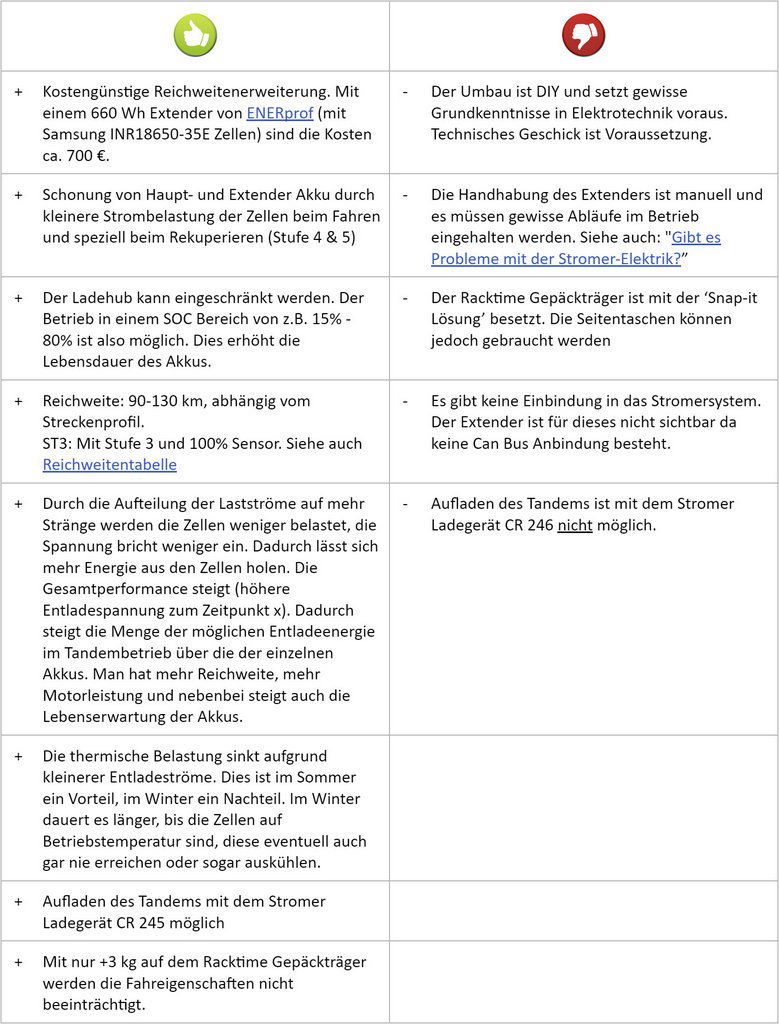
Pros & Cons
In addition to the gain in range, there is also a gain on the economic side. By distributing the discharge currents or charging currents (especially during recuperation) over more cell strings, the cells are subjected to less stress. This has a noticeable effect on the service life of both batteries and therefore on your wallet in the long term.
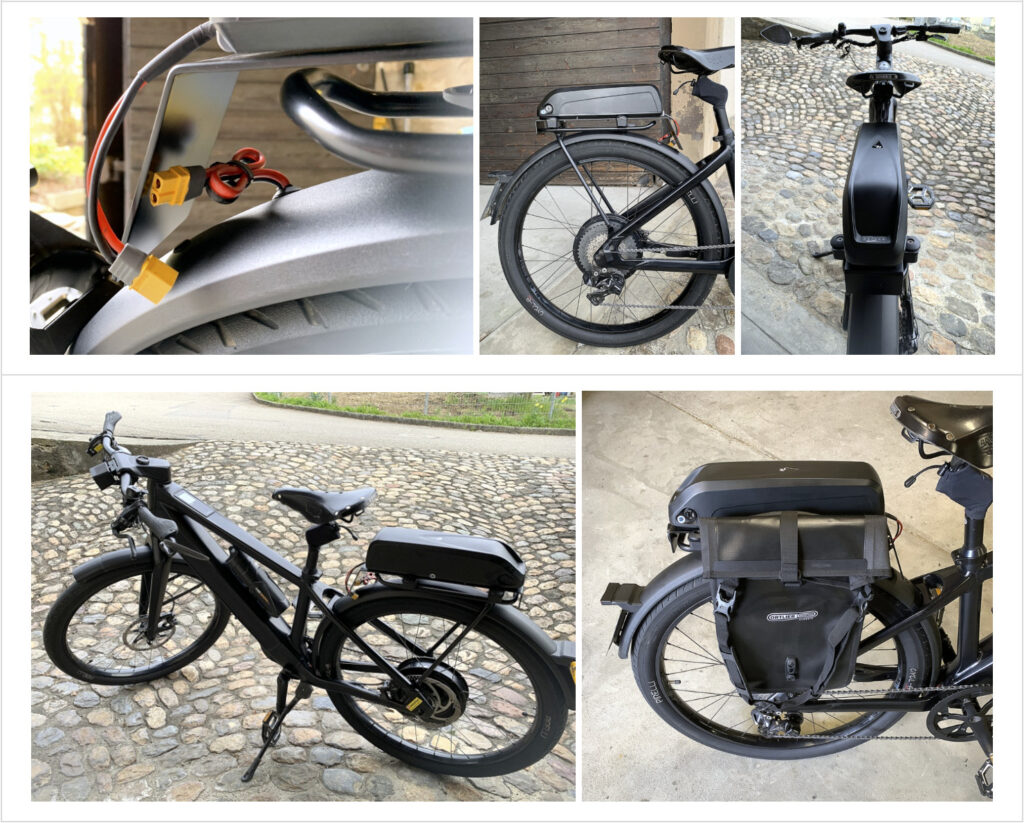
The end result with my ST3
Since the extender cannot be integrated into the Stromer electronics (CAN bus connection not possible), only manual operation of the battery remains. Charging and connecting to the Stromer's 48V system are therefore done by hand. In principle, there are no problems with this, but there are a few things to keep in mind.
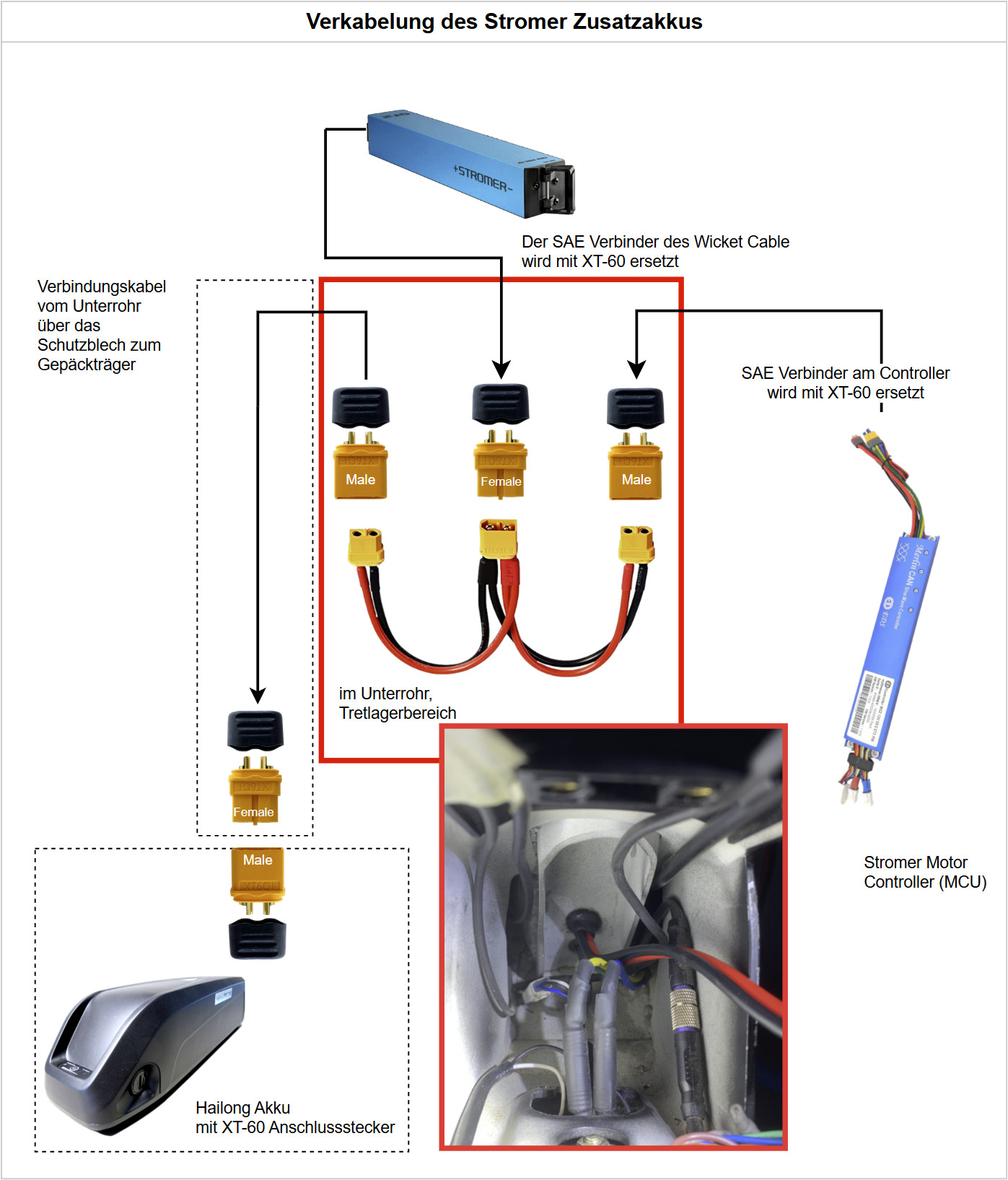
Meine Lösung ist eine „In-Frame“-Variante, heisst, die Kabelführung zum Extender verläuft im Rahmen. Da mein ST3 Sport M keinen Einbau im Rahmendreieck zuliess, musste ich auf den Gepäckträger ausweichen. Mit dem Racktime Snap-it Adapter (nicht zu verwechseln mit dem Snap-it-Adapter 2.0) und einer Montageplatte (Eigenkostruktion) konnte ich eine mobile Lösung für den Extender finden. Den 48-V-Anschluss des Extenders realisierte ich mit einem XT-60-Splitter zwischen Akku und Controller im Tretlagergehäuse, sodass ein Rückbau möglich wäre. Die „In-Frame“-Variante benötigt zwei Bohrungen: eine oberhalb der bereits bestehenden Durchführung für das Rücklicht im Tretlagergehäuse und eine im hinteren Schutzblech.
Please note
- Charge level Idealerweise sollten beide Akkus vor dem Verbinden auf dem gleichen Lade- bzw. Spannungsniveau (SoC) sein. Idealerweise geht das, wenn der Extender mit dem Stromer verbunden ist und beide Akkus mit dem Stromer-Ladegerät CR190 oder CR245 vollgeladen werden. Mit dem lüfterlosen CR246 funktioniert das gemeinsame Laden beider Akkus nicht.
Gemeinsames Aufladen heisst nicht, dass beide Akkus wirklich das gleiche Spannungsniveau aufweisen. Je, nach BMS und Zellentyp des Extenders kann dieses den Extender früher vom Ladevorgang trennen und es verbleibt eine Differenzspannung zwischen Stromerakku und Extender. Siehe nächster Abschnitt.
Ich lade meinen Extender und den des Stromers jeweils mit den eigenen Ladegeräten. So hatte und habe ich keine Probleme. Es empfiehlt es sich allerdings, die Ladeschlussspannung beider Akkus vor dem Verbinden zu prüfen. Sie sollte bei 48-V-Akkus bei max. 54,6 V, kann in der Praxis aber auch leicht darunter liegen. - Unequal charge level: Uneven charge levels [%] in the batteries also result in different voltage values and can lead to error E 21000D.
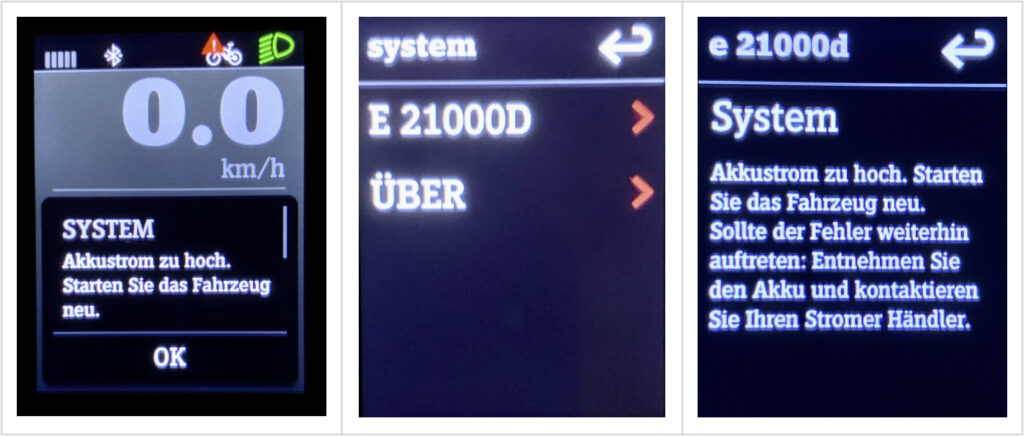
- Stromer battery voltage higher than extender voltage Ab einer Spannungsdifferenz von > 0,7 V spricht nach dem Verbinden der Überlastschutz des Stromer-Akkus an (Fehlermeldung: „Akkustrom zu hoch, starten Sie das Fahrzeug neu“ – Fehler E 21000D) und der Akku wird abgeschaltet. Der Fehler kann mit OK im Omnibildschirm quittiert werden, danach kann weitergefahren werden. Dabei wird der Extender leergefahren, da der Stromer-Akku abgeschaltet ist. Erkennbar ist das auch daran, dass sich die SoC-Anzeige im Omni nicht ändert – bei Start mit vollem Akku also bei 100 % bleibt. Grund: Der Extender-Akku hat keine CAN-Bus-Anbindung zum Stromer, weshalb dieser den Ladezustand des Extenders nicht kennt.
Workaround: Fahre ein paar km ohne Extender und verbinde den Extender erst dann. - Stromer battery voltage lower than extender voltage A balancing current flows, which is limited to 15 A (max. recuperation current) by the Stromer BMS. The voltage difference can therefore be higher than 0.7 V. Theoretically, the Stromer battery could also be empty and would then be „recuperated“ (charged) with 15 A via the extender until both batteries have reached the same voltage level. This is not recommended, as the charging current per cell string exceeds the specifications of the individual cell. see auch „Akku nach Rekuperation defekt“. Mein Extender hat zusätzlich eine 20-A-Sicherung in der Zuleitung zum Stromer eingebaut, für den Fall, dass der Stromabfluss aus dem Extender aus irgendeinem Grund zu hoch sein sollte. Ein ST2S-„Syno Drive“-Motor zieht bei Normalbelastung 20–24 A und bei Spitzenbelastung 32 A aus den Akkus. Pro Akku sind es also 16 A , da sch die Ströme 50/50 aufteilen.
- Stromer battery voltage higher than extender voltage Ab einer Spannungsdifferenz von > 0,7 V spricht nach dem Verbinden der Überlastschutz des Stromer-Akkus an (Fehlermeldung: „Akkustrom zu hoch, starten Sie das Fahrzeug neu“ – Fehler E 21000D) und der Akku wird abgeschaltet. Der Fehler kann mit OK im Omnibildschirm quittiert werden, danach kann weitergefahren werden. Dabei wird der Extender leergefahren, da der Stromer-Akku abgeschaltet ist. Erkennbar ist das auch daran, dass sich die SoC-Anzeige im Omni nicht ändert – bei Start mit vollem Akku also bei 100 % bleibt. Grund: Der Extender-Akku hat keine CAN-Bus-Anbindung zum Stromer, weshalb dieser den Ladezustand des Extenders nicht kennt.
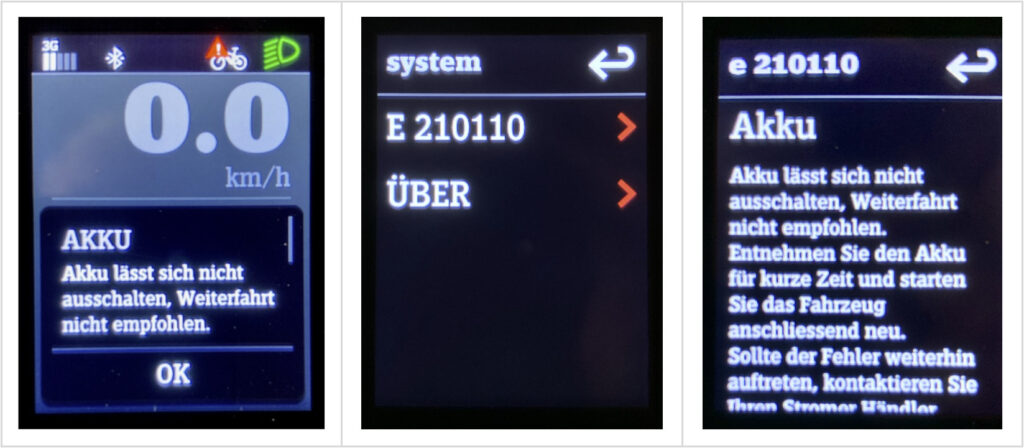
- Connecting and disconnecting the extender: Der Extender darf erst nach dem Starten des Stromers verbunden werden. Ebenso muss er nach einer Fahrt getrennt werden. Geschieht dies nicht, spricht die 48-V-Abschaltüberprüfung des Akkus an, sobald der Stromer in den Standby geht. Die Fehlermeldung im Omni lautet: „Akku lässt sich nicht ausschalten. Weiterfahrt nicht empfohlen – Fehler E 210110“Since firmware 4.3.3.2 from March 11, 2021, the driving authorization is also revoked. While you can continue driving after pressing OK for error E 21000D, with E 210110 the extender must be disconnected, the power supply restarted, and then the extender reconnected.
Cable diagram
Components, Costs, Experience
| Category | Details |
|---|---|
| Conversion costs (total) | 700 € |
| Included components | Akku, Netzteil, Kabel, Tüllen, Stecker, Buchsen, Snap-it-Adapter, Akkuträgerplatte |
| Battery | Hailong PRO frame battery Li-Ion 48V, 13.8Ah (660 Wh), XT-60 connection (manufactured by Enerprof.de > no longer in the range) Alternative: JERICHO, 48 V, 15Ah |
| Cell type | INR18650-MJ1 (LG) |
| Gross energy | 1643 Wh (extender with BQ983) |
| Battery mod | Snap-it-1.0-Adapter |
| Mounting plate | Eigenkonstruktion mit 2 Distanzplatten (L=120; B=32; D=2 mm) damit ich die Ortlieb Sport Roller Satteltaschen trotz Extender montieren kann. |
Practice reach upon commissioning on March 20, 2023
| Test drives380 - 1520 Hm | 12 - 28 °C | 10 trips with Level 3 and 100% sensor |
| Range (min. - max.) > Both batteries new | 97 - 136 km |
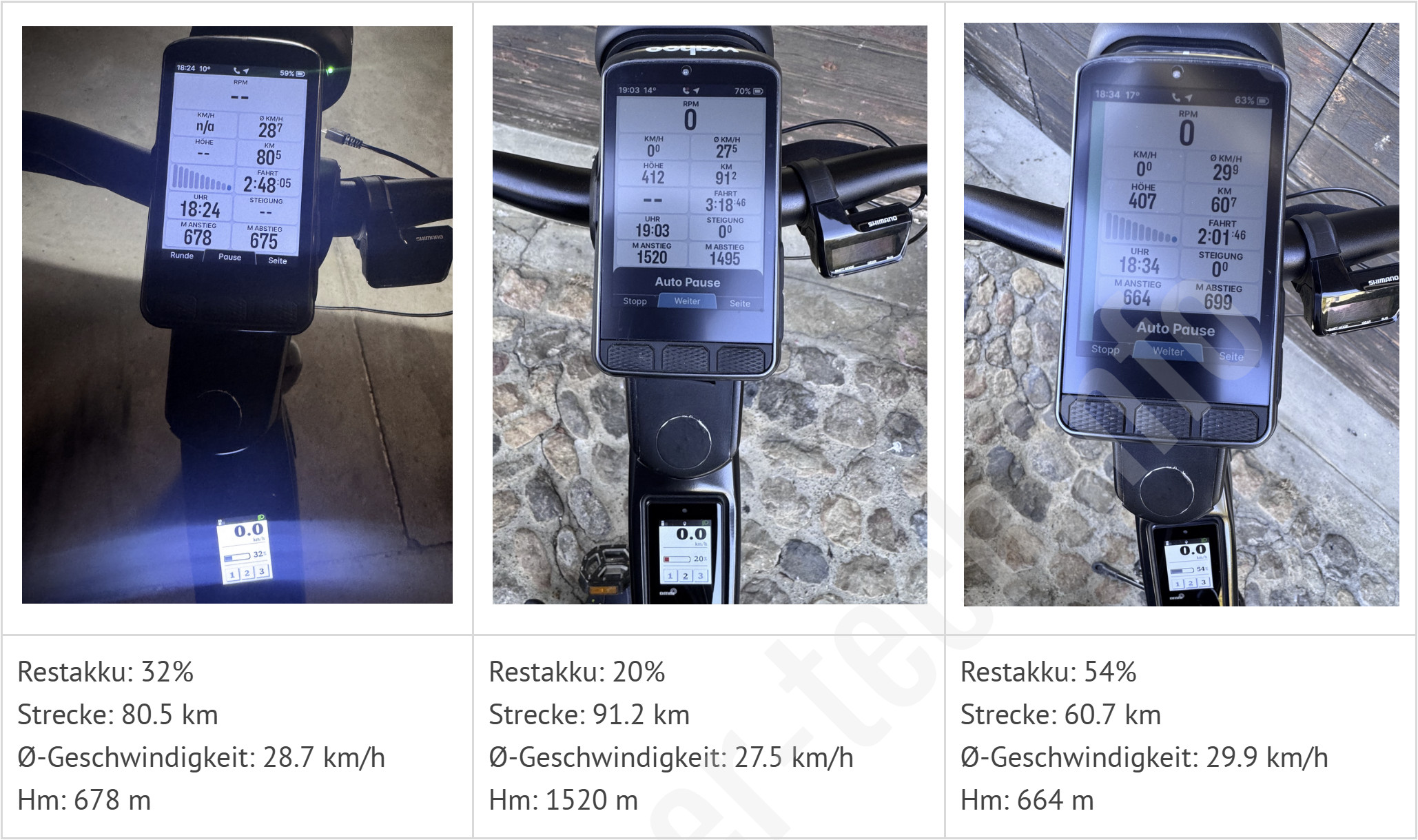
Three years later, March 2026
Die Tandem-Reichweite hat sich im Schnitt um etwa 20 km gegenüber dem Neuzustand verringert. Der SoH des Stromer-Akkus liegt bei 81%, gefahren sind 21’800 km. Anbei drei Strecken welche ich im März 2026 gefahren bin. Der Drehmomentsensor ist dabei auf 100%, alles in Stufe 2 gefahren, ausser die Anstiege in Stufe 3.
Further solutions
In addition to my Snap-it/Racktime variant, there are also other solutions on the net:
kawajan74 | JM1374 / JM1374 - 2 | cookiemonster
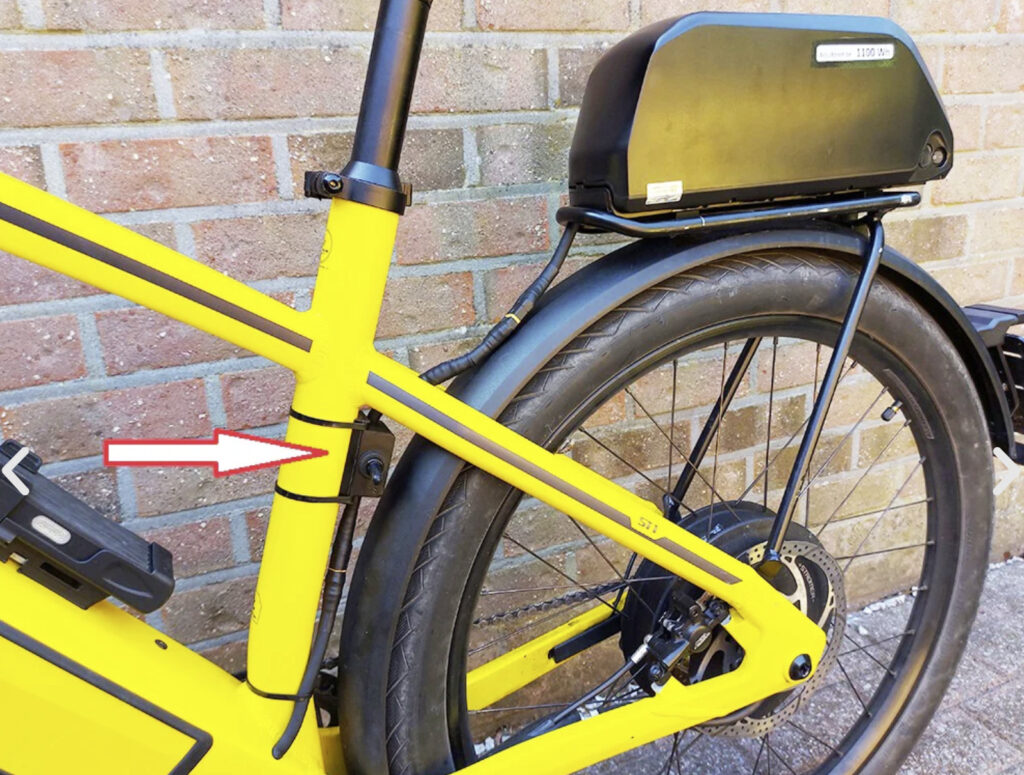
In Belgium there is the company accuboost.be which offers a dual battery system with an additional battery for Stromer. Depending on the space available, the additional battery can be accommodated in the frame triangle or the luggage rack.
There are three extender solutions (as of Nov. 2025):
„Compact“ (1146 Wh) - 895 € (incl. 21 % VAT)
„Midi“ (1188 Wh) - 930 € (incl. 21 % VAT)
„Maxi“ (1426 Wh) - 1095 € (incl. 21 % VAT)
The disadvantage of this solution is that the batteries can only be operated sequentially via a changeover switch. Battery-saving parallel operation is not possible.
Hello, the external battery is coupled with the „Stromen“ and was charged with a CR245; we charged it together for a few days. Kind regards
Johan
If both batteries are charged together with the CR245, it's still possible that the final charging voltage of the two batteries will not be the same. This is possibly due to the BMS, the cell type, or both in the extender, causing the charging process in the extender to end earlier. This results in a voltage difference between the two batteries. If it's higher than approximately 0.7V, error E 21000D appears.
I always charge my Tandem separately, meaning with their respective chargers: the Stromer with the CR245, and the Extender with the supplied charger. Initially, I also measured the final charging voltages, but found that both batteries remain within a 0.7V difference at the final charging voltage when charging ends, and I don't receive an error when connecting them.
A workaround is also mentioned in the article here.
Hello, the bicycle is completely fine, but when I connect the external battery, the display shows the message „SYSTEM: Current too high, please restart the vehicle.“
Do you have any idea what I'm doing wrong?
Sincerely,
Johan
Hello,
I'm back. Which Snap-It adapter did you use? I ordered one, but it doesn't fit at all. And where can I find a battery carrier plate like that?
Sincerely,
Johan
You might have the Snap-it 2.0 ordered (It is not compatible with the Stromer's Racktime luggage carrier) or the mounting cams are not adjusted. They are adjustable. You need the Snap it Adapter
I had the battery plate manufactured, it's a custom design.
Thank you again for your previous answer. I only have a CR246 and cannot find a CR245. Why can't I charge the two batteries together with a CR246?
The reason likely lies in the different firmware of the two chargers. They also come from different manufacturers and have different properties besides just charging. For example, the CR245 can potentially revive a deeply discharged battery, while the CR246 cannot. In turn, the CR246 offers trickle charging, which the CR245 cannot do.
Hello,
What type of connector to use between the Stromer default connectors and the XT-60?
thank you very much,
Johan
There is no connector. The old connectors (SAE, T-Dean, etc.) have been removed from the controller and the connection cable and replaced with male and female XT-60 connectors. See the corresponding image showing the wiring diagram.