
General
NMC811 batteries (Nickel 80 %– Manganese 10 % – Cobalt 10 % ) are the common batteries for e-bikes. The most important terms related to aging are as follows:
- SoH (State of Health): SoH refers to the health status of a battery. It relates to the nominal capacity and is indicated in [%]. Example: For a battery with an SoH of 70 %and a nominal capacity of 1,000 Wh, 700 Wh can still be used. The SoH could be determined by fully discharging the battery (SoC = 0 % ), then fully charging it, and checking how much energy can be recharged up to 100 % SoC. In practice, however, it is not quite that simple. To accurately determine SoH, one needs the internal resistance, insulation resistance, cell drift in loaded, empty, and full states, as well as the CAC.
- CAC (Current Actual Capacity or Capacity at Charge): The CAC is the concrete, measured capacity of a battery in a specific cycle. It is the central measurement for calculating the SoH (the percentage of capacity loss).
- Calendar aging: Calendar aging refers to the aging of the battery during storage without use. It depends on factors such as cell type, chemistry, storage temperature, and state of charge (SoC), and it is nonlinear. Collective knowledge on the internet indicates values of 0.5–3 % capacity loss per year (depending on storage conditions, especially temperature). Even with optimal storage, the battery's capacity continuously degrades.
- Cyclical aging: Cyclic aging occurs due to repeated charging and discharging cycles. Each cycle leads to chemical reactions that impair the battery's performance over time. Key parameters include charge management (including recuperation), discharge currents, operating temperature, C-rate (charging rate), and DoD (Depth of Discharge). A blanket percentage cannot be given, as too many factors are involved. Today's lithium-ion batteries have a cycle life of 300 up to several thousand cycles before reaching EOL (End of Life). Battery technology is rapidly evolving – in the near future, cyclic aging will only play a minor role, as the product in which the battery is used will reach the end of its life cycle beforehand.
- Internal resistance: The internal resistance of a battery refers to the resistance within each cell that opposes the flow of current. This causes a voltage drop when the battery delivers power. Increasing internal resistance leads to reduced power output, increased heat generation, and faster capacity loss – thus directly affecting the performance, safety, and lifespan of lithium battery packs.Source)
Jeder NMC-811-Akku verliert ab dem Herstellungstag kontinuierlich Kapazität. Er altert durch Lagerung (kalendarisch) und Nutzung (zyklisch). Exakte Werte hängen von den individuellen Nutzungsbedingungen ab. Besonders kalte und warme Temperaturen fördern bei Li-Ionen-Akkus die Alterung.
Optimaler Betriebsbereich: 20 °C bis 35 °C In diesem Fenster arbeiten chemische Reaktionen effizient und ohne übermäßige Alterungserscheinungen.
Maximaler Temperaturbereich (Entladen): -20 °C bis 55 °C
Bei Temperaturen über 45–50 °C setzt ein stark beschleunigter Abbau der Passivierungsschicht (SEI) ein.
Wenn der NMC811-Akku im Bereich von 20 % bis 80 % SoC und bei Zelltemperaturen zwischen 15 °C und 35 °C betrieben wird, lässt sich die Degeneration drastisch reduzieren und eine hohe Zyklenzahl erreichen.
Further definitions of terms can be found in my compendium: 'The Li-ion battery | theory and concept compendium'.
Wo wird der SoH angezeigt, was ist bezüglich Garantie zu beachten?
Wo der SoH in der Omni App und dem Omni angezeigt wird, und was bei einem Garantiefall zu beachten ist, kann here can be read here.
Own experience
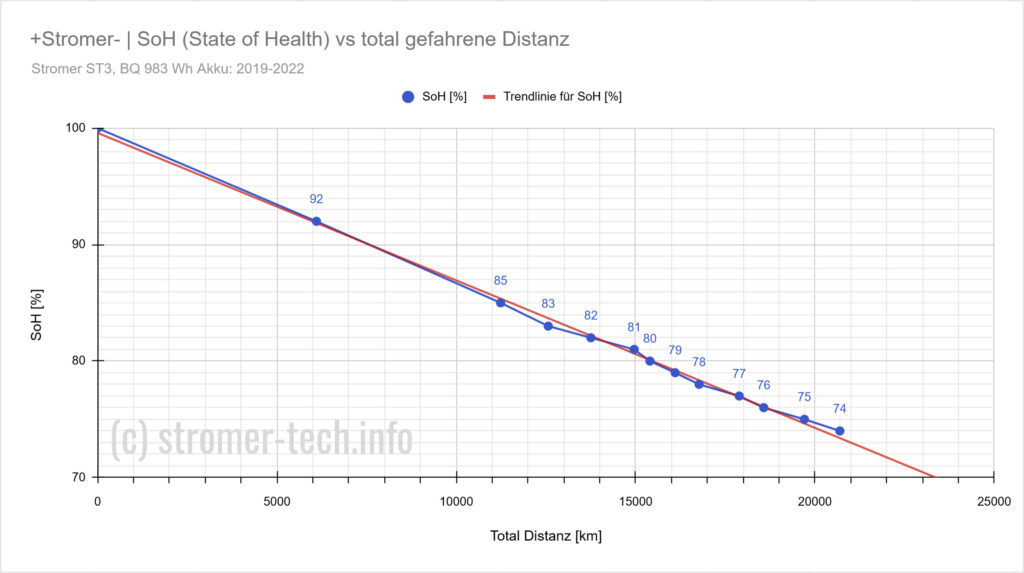
Evaluation from forums
Ein Einzelmessung kann natürlich nicht als Referenz dienen, deshalb habe ich eine Auswertung von 60 Rückmeldungen (Omni Screenshot oder textlich erwähnt) aus verschiedenen Stromer-Foren und Facebook-Gruppen gemacht.
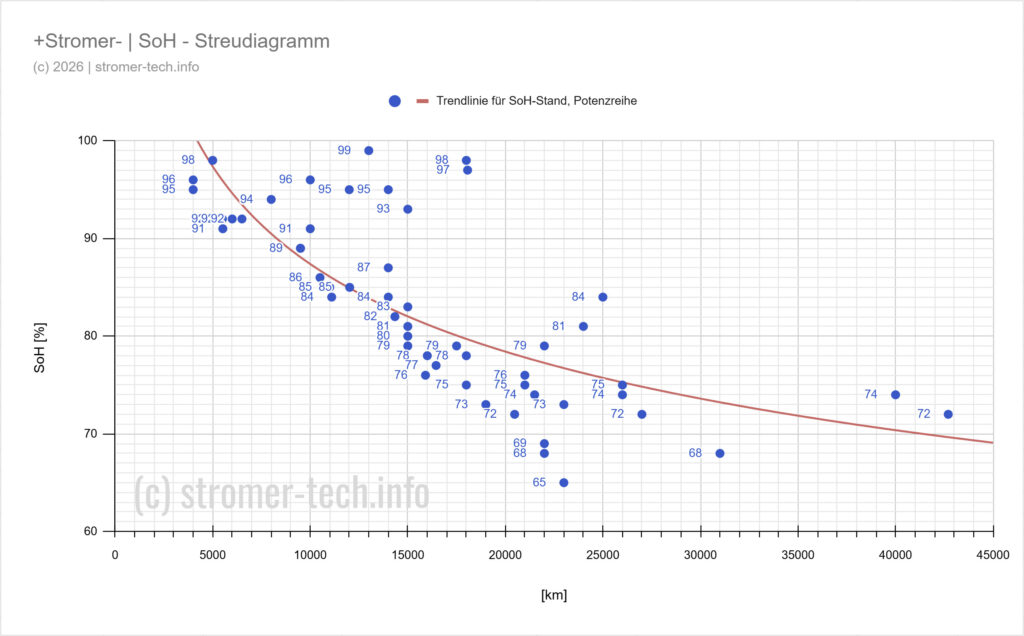
Stromer gibt eine Garantie von 75% SoH nach zwei Jahren. Aus der Statistik lässt sich folgende Aussage zum SoH Verlust bzw. der Garantie-Reichweite ableiten.
Slow down ageing / extend service life?
There are indeed ways to slow down the aging process. However, these depend heavily on the usage profile or everyday conditions. Positive factors for slowing down the aging process include:
- Begrenzung des Ladehubs bzw. Ladefensters: nicht vollständig laden, aber auch nicht leer fahren (siehe oben unter General).
- Proper charging: not in the cold or immediately after a long drive on hot summer days – let the battery cool down first.
- Avoiding recuperation levels 4 and 5 on long downhill descents (more details) here).
- Do not leave the Stromer in the sun for extended periods.
- Mit Fahrstufe 1 und einem reduzierten Drehmomentsensorwert fahren. Das bedeutet wiederum mehr Eigenleistung und geringere Geschwindigkeit.
See also the chapters:
> AKKU - ,Self-discharge of a BQ983 battery‘
> AKKU - ,‘Extend service life?‘
> AKKU - ,Maintenance: Mechanical / in operation / storage / safety‘
> PIMP mySTROMER - ‚Extender battery‘