
What is recuperation?
In so-called recuperation, braking energy is recovered. This happens during braking by converting the released energy in the generator – on Stromer S-Pedelecs, this is the hub motor – into electrical energy. This energy is fed back into the battery and can be used again for support during operation. The principle is familiar from old bicycle dynamos that powered bicycle lights, from electric cars where braking energy is also fed back into the battery, and from trains for a very long time.
- Kinetic energy When braking or driving downhill, the vehicle possesses kinetic energy.
- Hub motor as generator: The hub motor in the wheel hub is driven by the motion of the wheel. Instead of driving the wheel, it is now self-driven, acting like a generator.
- Conversion to electrical energy The hub motor converts mechanical kinetic energy into electrical energy. This happens through induction (the „dynamo effect“), a physical principle where the movement of magnets in a coil generates electrical voltage.
- Feedback to the battery: The generated electrical energy is fed back into the battery, thereby charging it and increasing the vehicle's range.
How Stromer works
The advantage of a hub motor is the possibility of recuperation. The mid-motor does not have this capability. The TDCM hub motor used by Stromer acts like a dynamo in this regard: it converts the rotational movement of the rear wheel into electricity, which recharges the battery. This is particularly interesting on downhill descents, where recuperation is used as an engine brake, reducing wear on the braking system.
The system had one level for the 36V models (ST1, V1, V1.1 with handlebar display), and two levels for models with the Omni display.
Display on the handlebars
Regeneration is activated via a reed switch on the right brake lever. It is only active from 50 % battery charge and must first be activated in the menu (Code 1009 = 1). With Code 1011 the engine braking strength can be adjusted (maximum value 99). There is Rekup 1 (gentler descents) and Rekup 2 (steeper descents).
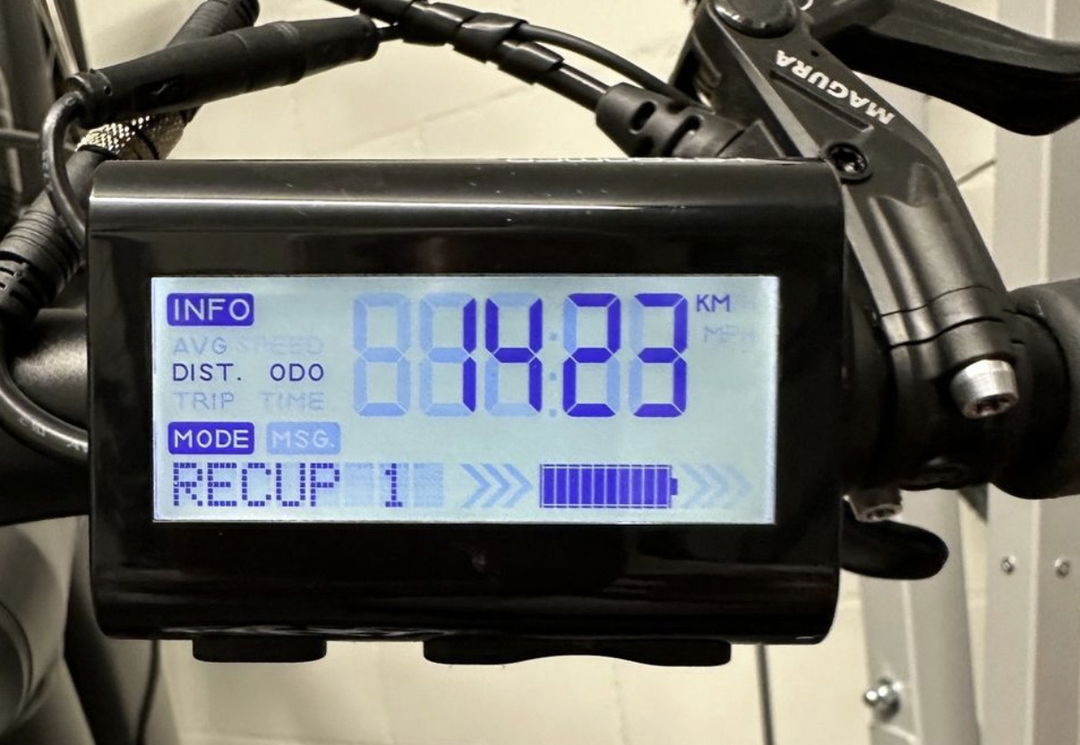
Omni Dipslay
1st level: Recuperation via the brake levers
In the first third of the brake lever travel, electrical recuperation is activated via a reed switch in the brake lever. If the lever is pulled further, the mechanical/hydraulic braking system engages. The recuperation strength on the left brake lever is approximately one-third to one-half of that on the right brake lever.
The bar above the battery charge level shows the current energy flow. If the bar builds up from left to right, the bike is in recuperation mode – current is flowing back into the battery. The longer the bar, the greater the energy flow. The maximum deflection is approximately two-thirds of the display width. The bar changes from gray to red when the maximum value is reached.
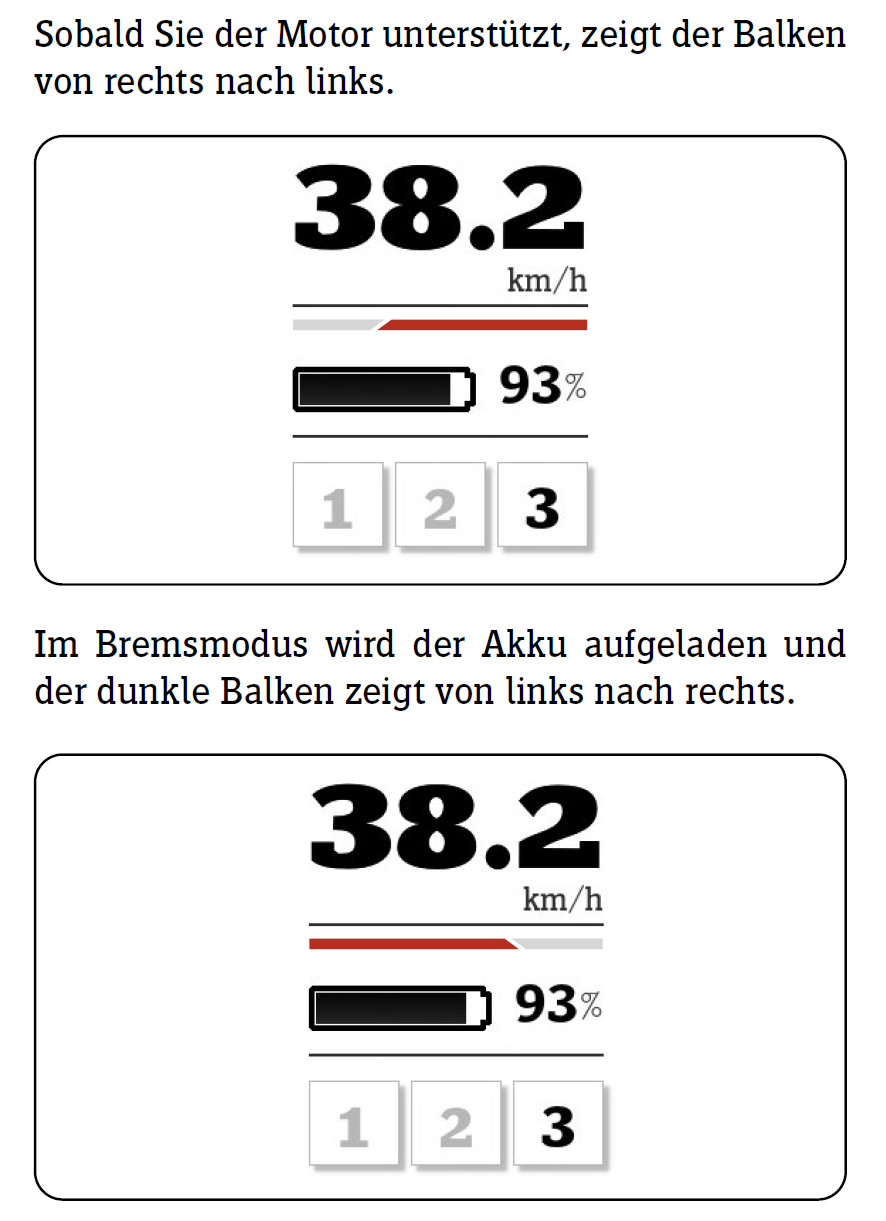
With the firmware update SUI FW 4.5.0.3 from 03/05/2025, recuperation will be additionally strengthened when both brake levers are operated. This allows for even better control of recuperation.
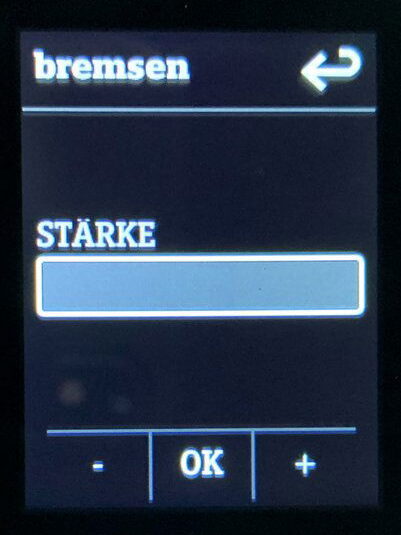
To adjust the overall effect of the recuperation strength, press MENU → BIKE → BRAKES → „Strength“ in the Omni-Display and adjust it with the plus and minus buttons. In the Omni app, the setting is located under CONFIGURATION → SENSORS → „Brake Sensor“. The setting affects all support levels, but is independent of the recuperation levels, which can be selected via the control ring, both for classic recuperation and via „Cruise Control“ on the handlebars.
2nd level: Recuperation via the control ring with the [-] and [+] button
Classic Recuperation (Recup):
The second level is activated by pressing the [-] button on the control ring for 2 seconds and can be varied in 5 stages by repeatedly pressing [+] and [-]. It is deactivated by pressing and holding [+] and [-]. The latter also happens automatically when the speed drops below approximately 10 km/h.
The effect of recuperation is speed-dependent. If you are already traveling fast on a steeper downhill and activate recuperation, it will not be as strong as if you activated it at the beginning of the descent while still at a moderate speed.
It shuts off at high speed on a steep downhill (at approx. 55-60 km/h) because the maximum charging current of the battery of 15 A would be exceeded, but it automatically reactivates as soon as the speed drops below this limit again.
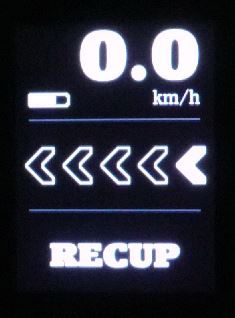
Cruise control (cruise control)
With the Cruise Control function (from Stromer firmware version 4.4.3.3 dated 11/20/2023), the previous recuperation mode is supplemented with a downhill assistant.
The cruise control function automatically adjusts engine resistance (recuperation) to maintain speed, even on changing gradients. It attempts to maintain the speed from the moment of activation (long press of the minus button). The cruise control speed can be adjusted up or down in predefined speed increments using the plus or minus button on the control ring.
In the Omni under MENU → BIKE → „Recup Mod...“ settings can be made to the recuperation mode. Here, „MODE“ can be used to choose between Cruise Control (standard function) and the previous Recup mode. In addition, „SPEED“ can be used to set the speed steps (default: 5 km/h) and „PEDALING“ can be used to set the pedaling force for automatic deactivation of recuperation.
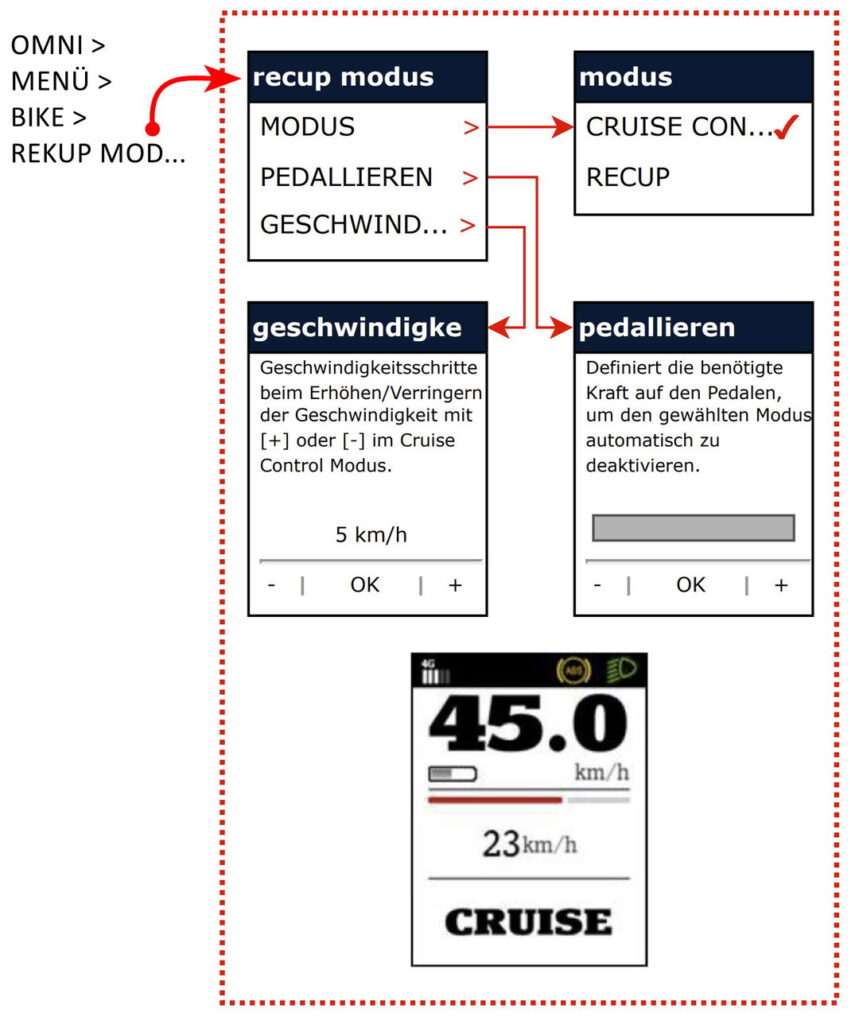
Go to the full OMNI flow chart here.
Range gain / Recuperation effect
Stromer speaks of a range gain of up to 20 % when using recuperation.
Practical test
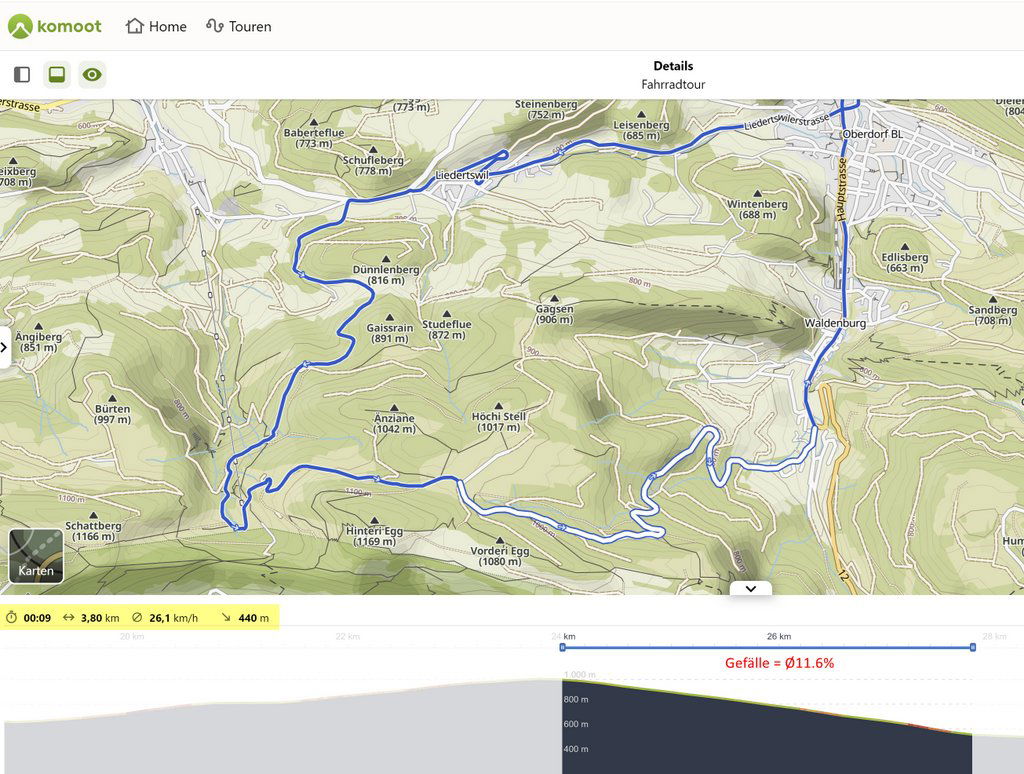
Maximum recuperation efficiency
The maximum regenerative braking effect (red bar) is not achieved at maximum speed, as the regenerative current would otherwise be too high for the battery. When using cruise control, the red bar typically appears at speeds between approximately 20 and 33 km/h and on a gradient of approximately 6–8%.
Summary
Energy recovery actually works well. However, there are limitations:
- A relevant charging or range gain requires a longer downhill stretch with a greater gradient (> 8 %) to utilize full energy recuperation (red bar in Omni).
- The battery must not be full.
- Der Motor produziert bei Anwendung der Rekuperation Abwärme. Bei Stufe 5 (100 % Rekuperation) und längeren, steilen Abfahrten läuft der Motor in den Überhitzungsschutz (gelbes Warndreieck). Nimmt man die Rekuperation zurück, leidet der Ladegewinn des Akkus, man kann aber länger rekuperieren.
- Regeneration in stages 4 and 5 pushes too much current into the cells, exceeding their maximum charging current, which is not beneficial for the battery's lifespan. See box below.
- To reach the double-digit percentage profit zone, two longer descents or several shorter ones on the tour would certainly be necessary. However, before you can descend, an ascent is usually needed first, which puts things in perspective.
- On a slight incline, the recuperation gain is lost in the background noise of consumption and is not readable on the capacity display in %.
Hello.
Sunny greetings from Geesthacht.
I just stumbled upon your great website.
You've gathered a lot of great information here.
I'll definitely stop by again when I have more time.
I just wanted to let you know that the link:
„The complete flowchart of the OMNI is available here.“
On the „Recuperation and Recuperation“ page“
„The file is not present“ is no longer working.“
Thanks again for your time that you invested here.
Best regards
Olaf
P.S.: I ride a ST5 with Ø 4000 km/year (average 35-40 km/h)
Thank you Olaf for the positive rating. And yes, it involves quite a bit of work, and sometimes something gets forgotten or lost in the web of many links.
I'm glad for any feedback from attentive readers who also take the time to give a brief response. Thank you very much!
Greetings from Stromer
Jurg