
Chain
My chain on the ST3 lasts about 10,000 km. If I change it, I always change the 11th sprocket as well. This is the one I ride most often. Every 2nd chain change - depending on wear - I also change the 13/15/17/19 sprockets.
See FAQ - 'Chain - measure wear'
See FAQ - 'Chain - number of links / brand?
Chainring
See PROBLEMS - Chain (sprocket) / pulleys and belt Chainring / bottom bracket - wear'
Cassette
Stromer has used and continues to use different rear derailleurs and cassettes throughout the evolution of its models. They all have one thing in common: they are a wearing part and without maintenance their service life is noticeably shortened. Depending on the model, the cassettes are modular, meaning that individual sprockets or sprocket groups can be replaced. When this must/should be done can be recognized on the one hand by the appearance of the sprockets, on the other hand a replacement is announced by the jumping or slipping of the chain.
A chain can already be out of tolerance at 4,000 km, but with good care and smooth shifting it can also last over 10,000 km. This is similar for sprockets. They wear out at different rates depending on the shifting frequency and use of the individual gears.
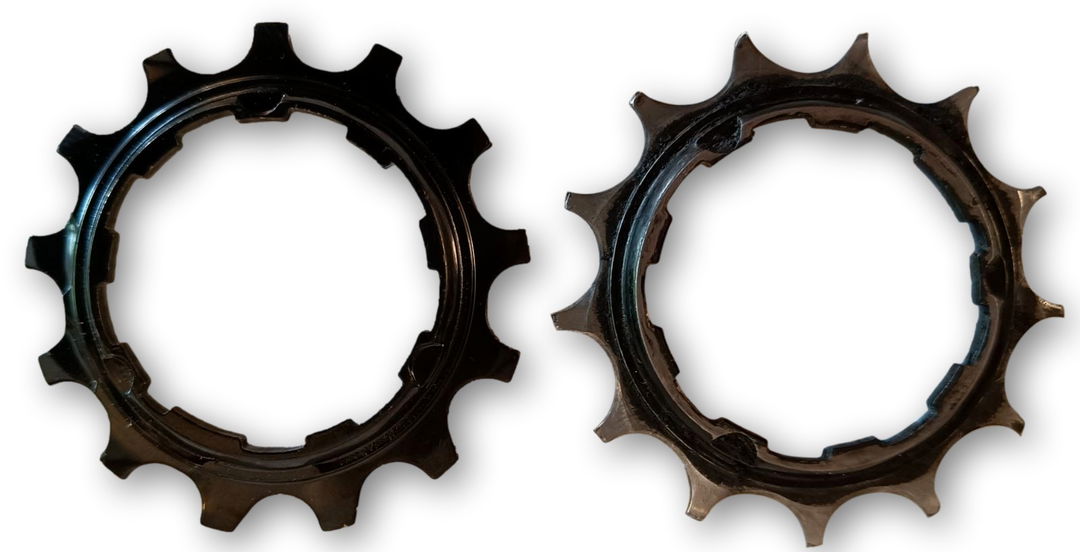
The sprocket on the right has clearly been in use for too long. The mechanical wear is clearly visible. If it were to remain in use when changing to a new chain, this would massively reduce its service life.
Rear derailleur / derailleur pulley
The two derailleur pulleys of a rear derailleur have teeth made of rigid PVC and plain bearings, which are also subject to mechanical wear. The pulleys have no load-bearing function and only serve to guide the chain. At Shimano, there are differences in size for higher quality product groups. The guide roller must be installed at the top and the tension roller at the bottom. Some of these are also bound to the direction of rotation, easily recognizable by an arrow on the roller.
Replacement is necessary when wear is clearly visible or the rollers no longer turn smoothly.
With my Shimano Di2 rear derailleur, the rollers are still ok after 30,000 km.
The rear derailleur also contains mechanical parts that are subject to fatigue rather than wear. For example, the tensioning set is responsible for the tension of the derailleur arm. It can break and the arm becomes paralyzed. Shimano offers various spare parts for the rear derailleurs, so that a repair is possible.
Life expectancy / costs: chain vs belt
There is much debate about the life expectancy of the chain and belt. The same applies to maintenance. In terms of costs, the chain drive clearly has the advantage when it comes to Stromer.
See SHIFTING - chain vs belt - 'Comparison: costs / care / (life) maintenance'
See PROBLEMS - chain (-blade) / pulleys and belts:
- ‚Pulley(s) / belt(s) worn‘
- 'Broken belt / has lost teeth'
Care / Maintenance
To keep wear and problems in the drivetrain to a minimum, it must be maintained regularly. More for the care of the Stromer, the drive, wear and tear, etc.