
Problems in general
The squeaking of wheel brakes is an old story and was already omnipresent with rim brakes. The problem was not eliminated with the introduction of disc brake technology in the bicycle industry. There are various reasons why disc brakes also squeal:
- The pads are new and not braked in
- The brake pads/disc are damp or wet
- The brake linings (pads) are glazed (grind the linings on a flat grinding plate)
- The brake pads are worn or old
- The brake disk is oily (e.g. after oiling the chain or a leaking brake caliper)
- Contamination on the windshield and/or pads
- The brake disc and/or caliper setting is incorrect
- The brake piston retraction is not working correctly
Specific Stromer
The rear brake in particular often makes squeaking noises on the Stromer. The front brake can also squeal. In addition to the reasons mentioned above, they may be amplified by design „peculiarities“ on Stromer.
At the rear, the brake disk is mounted directly on the left-hand flange of the hub motor. This acts as a resonance amplifier (drum effect). A solid, hollow rigid fork is installed at the front, which also serves as a resonance body.
There are also differences depending on whether braking occurs in wet or dry conditions. „Wet“ is always louder! The brake pad (sinter/organic = resin) also influences the soundscape.
A problem solution is usually not 100%% sustainable. As two power traders confirmed to me, the whimpering or squeaking cannot be permanently eliminated. Sooner or later it returns, no matter what you do. Rebuilding the system for another product also does not solve the problem, is correspondingly expensive, and Stromer fundamentally prohibits modifications to the braking system.
Solution approaches
1. Properly break in/bed in brakes
Before looking for other causes for the squealing, make sure that the brakes are braked in and, in the case of resin pads, that they are also burned in.
See BREMSEN - 'Brake in/burn in brakes'
Resonance damper disc for the rear wheel
Stromer offers a resonance damper disk for the rear wheel. It is mounted between the brake disk and the motor flange.
Practical experience: Works!
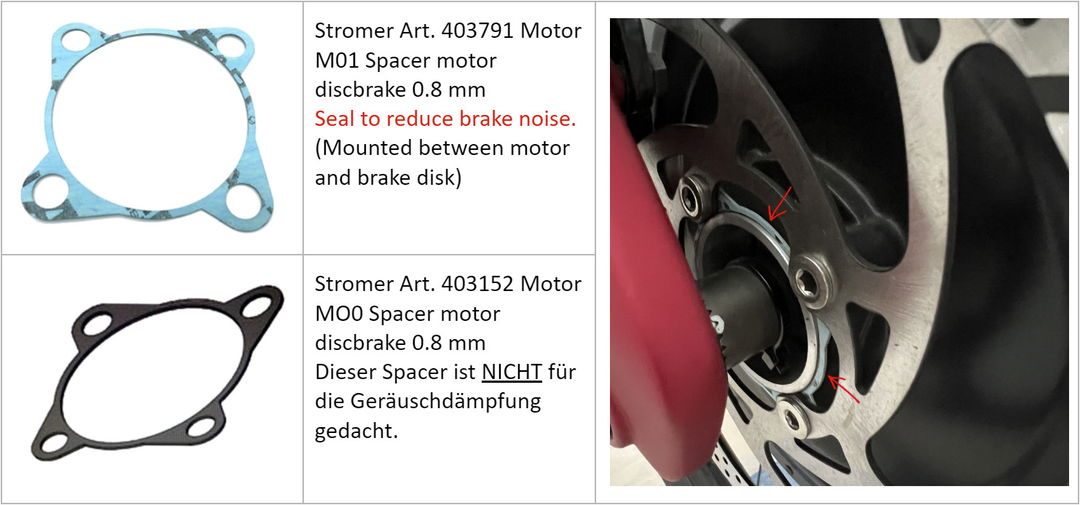
3. Use resin (organic) coatings
One way of reducing noise is to install organic (resin) surfaces. Noise reduction can be achieved at least in dry weather.
In the wet, resin pads squeal even more than the original sintered pads, at least until they are braked dry. They usually have a slightly softer pressure point, but then brake just as well as the sintered pads.
Practical experience: I've been using SwissStop brake pads on my ST3 for the past 10,000 km or so. Together with the Motor01 spacer, the combination is silent in dry conditions. In wet conditions, they also squeak.
4. Brake Silencer
From SwissStop there is the Disc Brake Silencer, a spray that diffuses into the brake pad to reduce noise.
Practical experience: A noise reduction occurs with the original Stromer TRP pads. However, the effect does not last very long and the silencer must be reapplied.
Copper paste
S-Ped riders also report that applying copper paste to the back of the brake pads helps.
Practical experience: None. The sluggish consistency of the paste allows for vibration damping.
6. Balancing weights as vibration dampers
The following solution is a somewhat unconventional approach.
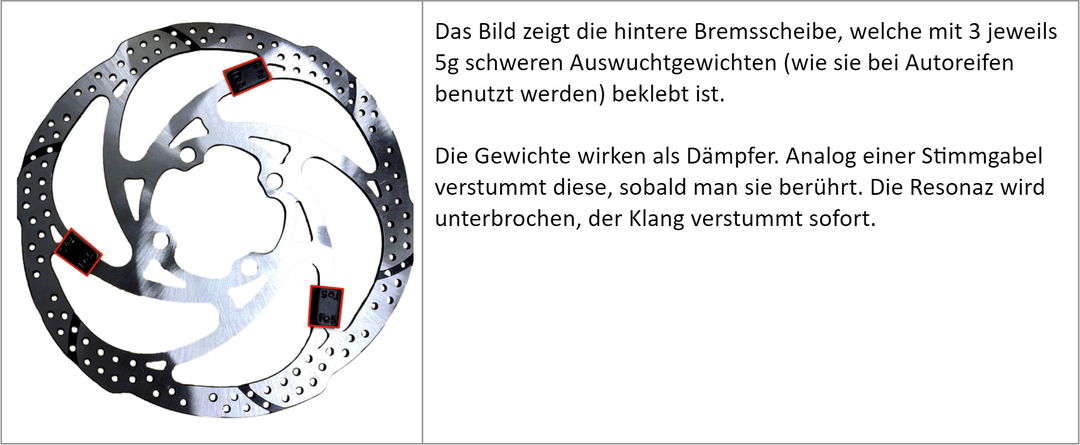
Practical experience: None
My experience with the ST3
Ich verwende hinten die Resonanzdämpferscheibe gemäss Lösungsansatz Zwei und fahre organischenBeläge von SwissStop (Disc 15E). Vorne verwende ich Resinbeläge von TopBrake (BD01-E+). Die Beläge habe ich sauber eingebremst, die Bremssättel jeweils genau zentriert sowie die Kolbenrückstellung kontrolliert. Mit diesen Massnahmen fahre ich bei trockenen Verhältnissen meist ohne Quietschen. Bei hoher Luftfeuchte ist manchmal ein kurzes Wimmern zu hören. Bei Regenwetter quietschen die Beläge immer.
Alternatives to the original pads
See BREMSEN - 'Spare parts....'
Links
Zum Thema Bremsen kann man Bücher schreiben. Wie beim Thema Akku oder Kette gibt es viele verschiedene Ansichten.
Ein paar weiterführende Links zum Thema:
> Solving problems with the brake - a list of problems and solutions (mtb-news.de)
> Scheibenbremse quietscht: die 7 wahren Ursachen (nicht Öl, nicht Nässe) (Olafs Pedal & Perspektive)
> The most common problems with disc brakes (lucky-bike.de)
> Ein Überblick zum Thema Bremsbeläge, deren Vor- und Nachteile oder Eignung, bietet u.a. die Seite flowzone.ch or velonerd.cc.
> Bremsen will auch gelernt sein, nicht nur wegen den Belägen, sondern um Unfälle zu vermeiden. Wie man richtig bremst, ist im Article by Sheldon Brown described.
Und:
See hier auf der Seite auch: BREMSEN – ,Bremsen einbremsen/einbrennen‘