
Drive concepts
There are basically three different drive concepts with different advantages and disadvantages: Front-wheel, mid-wheel and rear-wheel motors. An overview of the different drive concepts can be found on the page Special-E.de.
If you would also like to take a look at the mid-engines, you can read the article ‚The big e-bike motor comparison - 13 e-MTB motors in the test‚ from September 2023.
Stromer
Stromer uses Brushless DC motors (BLDC). BLDC is a marketing term for Three-phase machineswhich draw the AC voltage required for their operation from an electronic circuit that is connected to DC voltage is supplied. In contrast to a simple Direct current machine with carbon brushes is a Three-phase synchronous machine with excitement through Permanent magnets. The three-phase winding is controlled by a suitable circuit in such a way that it generates a traveling magnetic field which pulls the permanently excited rotor along. The control behavior is largely similar to a DC shunt-wound machine.
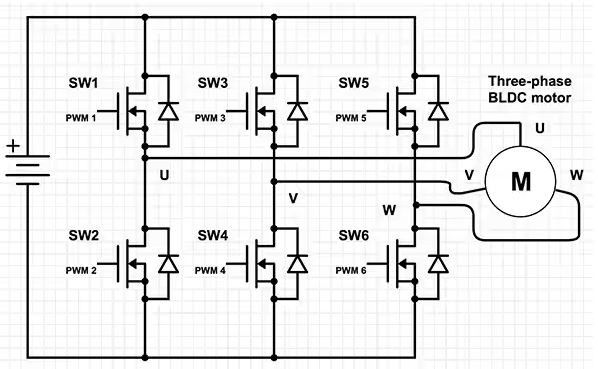
The circuit below uses six MOSFETs (SW1 to SW6) that act as electronic switches, grouped in pairs for each of the three phases (U, V, W). Control is achieved through Pulse Width Modulation (PWM 1 to PWM 6), which varies the width of the voltage pulses to activate the motor windings in a specific sequence. This electronic commutation generates a rotating magnetic field in the stator, which attracts and repels the permanent magnet rotor, thereby creating rotational motion.
Sensors
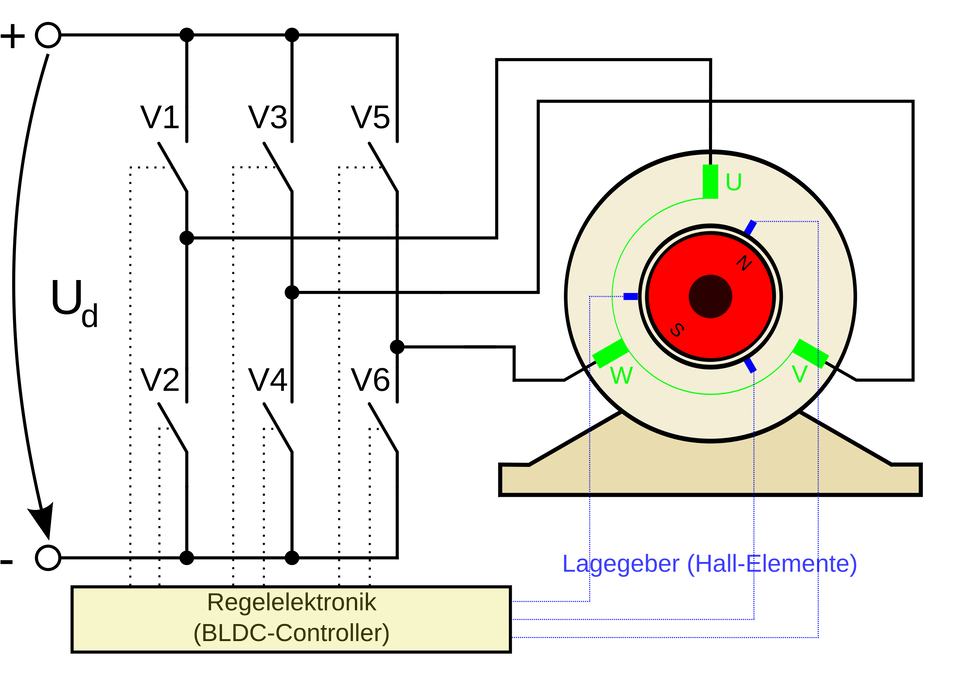
Hall sensors: As shown in the diagram above, position sensors, so-called Hall sensors, are required to control the BLCD motor. There are three of them with the following tasks:
- Feedback: The Hall sensors provide feedback to the controller, which enables precise control and regulation of the motor.
- Position detection: Hall sensors detect the position of the rotor in the motor based on the magnetic field generated by the rotor.
- Commutation: The information provided by the Hall sensors is used by the controller to activate the correct windings of the stator. Activating the correct windings generates a magnetic field that causes the rotor to turn.
- Speed detection: The Hall sensors can also be used to determine the speed of the motor by counting the number of Hall signals per time period.
Temperature sensor: A thermistor is used to protect the motor from overheating. A thermistor (short for Thermal resistor) is a temperature-dependent electrical resistance whose resistance value changes greatly depending on the temperature. There are two types:
- NTC thermistor (Negative Temperature Coefficient): The resistance decreases as the temperature rises.
- PTC thermistor (Positive Temperature Coefficient): The resistance increases as the temperature rises.
Stromer uses an NTC thermistor. The protective function of the motor is activated at approx. 135-140 °C. The power is first reduced and support is stopped at 150 °C until the temperature value has fallen below the critical threshold again.
Components used:
- Hall sensor: Honeywell SS461R
- Thermistor: NTC, 10 kΩ (25 °C and Beta value ~3500) - 15 kΩ
- MOSFET (power semiconductor) on the controller:
Ex. ST1x, ASI Controller: 10 pcs 1290 BV6319 | 2 pcs 1290 BV6U11
A possible replacement is an IRFB4110, for example:
- N-Channel FET
- VDSS of 100V (min. 80 V)
- RDS on, as low as possible <10 mΩ
- Diode over DS
- I max. >100A
- Housing TO220
Defects
See PROBLEMS - MOTOR - ‚Repairs‘ ...and other topics