
To increase the reach, there are various options:
- Manufacturers are increasingly relying on larger batteries – including Stromer with the ST7.
- Additional battery solutions (Extenders).
- The user has a reduction in assistance available via the gear selection or the torque sensor setting. Reducing one or both saves energy, but also means an increase in the user's own effort. According to common opinion, increasing cadence in particular is supposed to „save“ battery power - is that true? More on this under „Cadence“ further down.
Rough calculation of battery size
How do I determine which battery size I need?
In principle, the following energy consumption figures can be assumed for e-bikes/pedelecs with hub motors. The table is based on minimum pedaling effort.
| Mode | Description | Energy consumption |
| Minimum support | Motor only on inclines, slower setup | 6 - 8 Wh/km |
| Typical assist | ~40 km/h when pedaling, motor constantly switched on | 9 - 12 Wh/km |
| Power hungry | Do not pedal, do not put any load on the pedals or pedal very fast | 14 - 20 Wh/km |
Once the battery voltage is known, the next step is to determine how many ampere-hours (capacity) are required to cover the desired daily distance without the battery running out. The necessary capacity depends on how much effort the rider wants to put in, the speed at which they are riding, and the route profile.
Multiply the desired travel distance by the corresponding watt-hours/km from the table above to get the required minimum watt-hours (energy). Divide the result in [Wh] by the system voltage (36 V / 48 V) to get the minimum ampere-hours [Ah] that the battery must provide.
Example:
Distance: 45 km
System voltage 48V
Fast from A to B, max. support: Assumption 17 Wh/km
45 km * 17 Wh/km / 48 V = 16 Ah
It must also be taken into account that the battery is subject to an aging process from the first day after production. This is further accelerated by cyclic stress during use. If you want to cover the commute even after two years and in winter, approximately 20 % should be added to the result. This ultimately brings us to 19.2 Ah, which is almost exactly the nominal capacity of the Stromer BQ983 battery.
Additional battery
Stromer does not offer an official accessory battery solution. There is a lack of both an electrical interface and the corresponding software support.
What can you do if the battery isn't sufficient for your commute and cannot be charged at the office? The solution is an auxiliary battery, also called an extender. Besides significantly increasing the range, its use offers other benefits as well.
If you would like to know more, read PIMP mySTROMER - 'Battery - Extender' and 'Battery - Second battery box' continue.
Cadence / Self-generated power
Own work If you don't want to invest in an auxiliary battery, you can also work on your own effort. The more of this is provided, the more the battery is conserved and the range is increased. If you want to ride at the same speed, more personal effort is achieved by reducing the gear level and/or the torque sensor (in the Omni app: pedal sensor).
Cadence with mid-drive motor: For the mid-engine, there are ebikespass.de an interesting theoretical consideration of how cadence affects battery consumption.
The resultAt a low cadence of 50 rpm and medium pedal assist / gear (power: 150 W), the Joule losses are three times greater than at 85 rpm. The motor's efficiency at 50 rpm is 24.5 % lower than at 85 rpm.
Can the calculation also be applied to the hub motor?
Cadence with hub motor The calculation applied here should take into account the gearing, as it is located on the hub motor's axis and thus directly influences the motor's rotational speed. The cadence is essentially translated to the motor and does not directly act on it. The technical principle of the hub motor is particularly advantageous when higher speeds – and thus higher motor speeds – can be achieved.
Due to their construction, Stromer hub motors are inherently relatively sluggish (max. 395 rpm) and less efficient at lower speeds or at low speeds (< approx. 20 km/h). Efficiency decreases, and waste heat increases. Since this heat must be transferred from the stator to the rotor via an air gap, cooling is also not optimal, despite the large aluminum drum.
The speed/efficiency diagram of a 48V/500W hub motor looks like this:
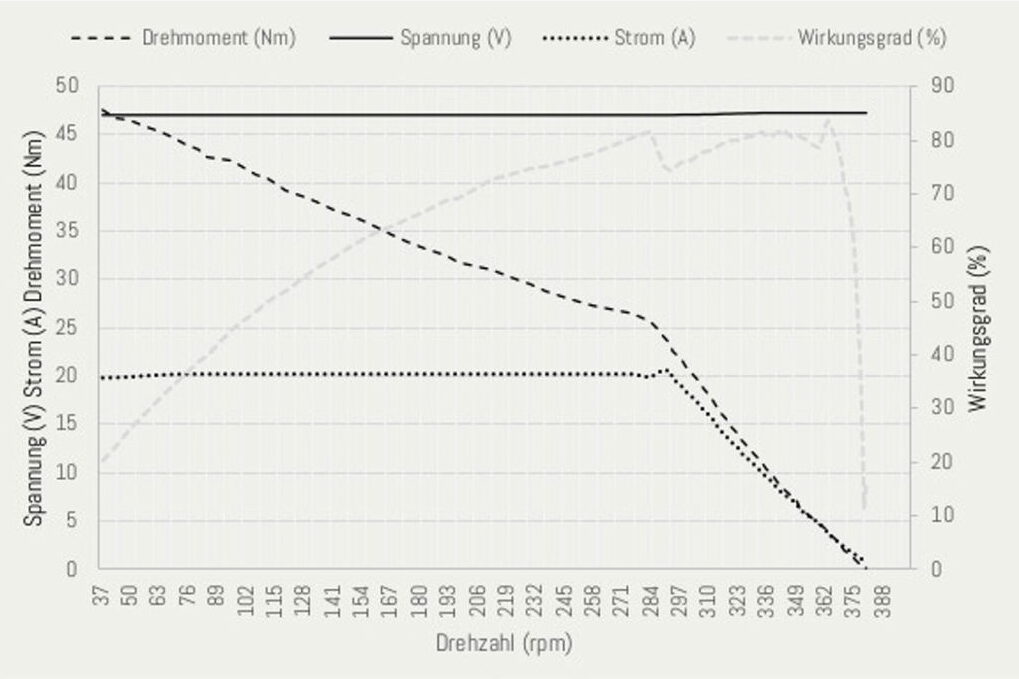
It is especially worthwhile on a mountain to shift down to take the strain off the chain. This reduces support and requires less energy accordingly. Since the cadence increases and ideally the speed remains the same, it can be avoided that the motor operates in an inefficient speed range, thus producing heat instead of propulsion.
A detailed graphical representation of the connections can be found at MOTOR – ,Simulation of Engine Data‘ to see.
Side effect on the body: And there's another aspect that applies to both drive concepts. Technically, cadence is about torque, and physically, it's about the circulatory system and the joints.
At high pedaling frequencies, the phases of muscle tension (contraction) are shorter. During a contraction, blood vessels are compressed, hindering blood circulation, which is important for oxygen and nutrient transport. Metabolic byproducts such as lactate are also better removed with good blood flow.
A higher cadence is better for the joints, as the peak loads are shorter and often lower. Sports medicine recommends a cadence of more than 75 rpm. In rehab, patients train at 75 rpm – this mark is considered the lower limit to keep the strain on the knees as low as possible.